
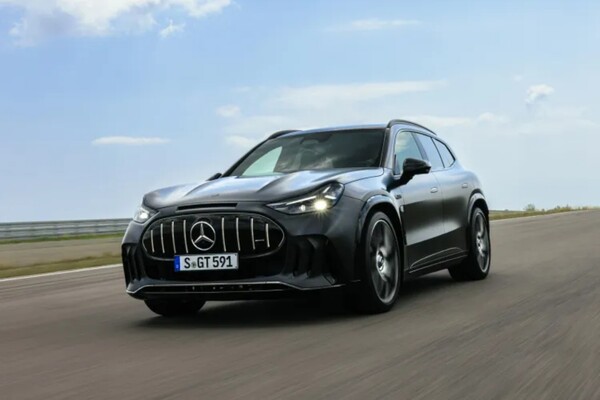
Mercedes-AMG has unveiled a large sport utility vehicle developed in-house from the outset for the first time in the brand’s history, as a pure electric model. It is targeting the high-performance electric SUV market with 1,153 horsepower and charging performance of up to 710 kW.
On Oct. 17, local time, tech media outlet The Verge reported that Mercedes-AMG unveiled the 2028 GT SUV. It is due to launch in the U.S. market in the summer of 2027. The new model is based on AMG.EA, AMG’s dedicated high-performance electric vehicle platform, and combines sports-car-level driving performance with the practicality of a large SUV.
The vehicle comes in three trims: GT 53, GT 55 and GT 63. The top-end GT 63 has three axial-flux motors and produces up to 1,153 horsepower. It has the same motor configuration as the previously unveiled AMG GT 4-door Coupe.
Chassis technology is also applied to control the movement of the large body. It adopts a hydraulic active suspension instead of a conventional mechanical roll bar, and is designed to reduce front-to-rear pitch and side-to-side roll during acceleration, hard braking and cornering. It also has a three-stage air spring and a 6-degree rear-wheel steering system as standard equipment.
Charging performance is a key competitive strength of the new model. The GT 63 and GT 55, fitted with a 128 kWh battery, support charging output of up to 710 kW. The GT 53, fitted with a 106 kWh battery, supports up to 600 kW.
Mercedes-AMG said it takes 12 minutes to charge the battery from 10 percent to 80 percent. The range that can be secured with a 10-minute charge is up to 450 km under the WLTP standard. The maximum range for the 128 kWh battery model was presented as 435 miles, about 700 km. Actual charging time and range may vary depending on charger performance, temperature and driving conditions.
The battery uses a design inspired by Formula One technology. It adopts nickel-cobalt-manganese-aluminum (NCMA) cathode material, a silicon-containing anode material and cylindrical cells. It is designed so non-conductive oil flows directly around each cell to manage heat evenly.
Mercedes-AMG explained that this allows the battery temperature to remain stable even under high output and reduces performance degradation during long driving. It is designed not only to boost short bursts of acceleration but also to maintain output during repeated high-load driving.
AI-based functions to enhance track driving performance are also included. A predictive performance management system uses track map data to adjust motor output by section. It is designed to save battery energy on downhills or technical sections and to use maximum output on uphills and long straights.
The goal is to reduce battery overheating and output limits and secure consistent lap times in repeated driving. The vehicle weighs 5,941 pounds, about 2,695 kg, for the GT 63. Mercedes-AMG emphasized that despite being a large SUV, it is lighter than some competing electric SUVs.
Inside, it applies a 14-inch display and the MB.OS operating system. The voice interface integrates AI functions based on ChatGPT, Microsoft and Google to support navigation settings, web searches and place searches. Its own onboard AI controls vehicle functions such as climate control adjustment, driving mode changes and interior lighting settings.
The company also focused on preserving AMG’s distinctive feel rather than the quietness of an electric car. It recorded actual AMG V8 and six-cylinder engine sounds and applied them to the vehicle’s sound, and implemented a sensation similar to mechanical shifting through paddle operation. A seat vibration function is also linked to the sound. The AMGFORCE Sport+ driving program is provided as standard across all trims.
The GT SUV expands AMG’s electrified lineup from high-performance electric sedans to SUVs. It is seeking differentiation in the large electric SUV market by combining ultra-high-output motors, ultra-fast charging, battery thermal management and AI-based driving control.
 Jinju Hong (홍진주)
hongjj@d-today.co.kr