
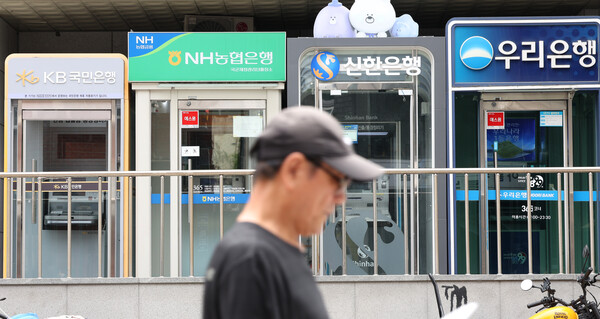
South Korea's banking sector is speeding up digital transformation and management efficiency, but it is not translating into what customers and employees feel on the ground. As mobile banking spreads, branches and staffing are steadily shrinking, and financial services that are difficult to handle remotely are being concentrated at remaining outlets. People on the ground say the situation is repeating, with customers waiting for consultations and employees complaining of heavier workloads.
As of Oct. 19, the number of branches at domestic commercial banks fell 276, or 4.9 percent, to 5,381 at the end of June this year from 5,657 at end-2022, according to the financial sector. Over the same period, the number of automated teller machines (ATMs) fell 4,610, or 15.7 percent, to 24,711 from 29,321.
The decline is also clear among the five largest banks — KB Kookmin, Shinhan, Hana, Woori and NH Nonghyup Bank. Their combined number of branches stood at 3,748 at the end of last year, down 94 from end-2024. Total employees also fell 1,046 to 67,733 over the same period.
Banks have said they need to streamline branch and staffing operations as demand for in-person services falls with the expansion of mobile and internet banking. Many tasks once handled at the counter, such as transfers, inquiries and opening savings and time deposit accounts, can now be done with a smartphone.
But the shift to remote services has not led directly to improved customer convenience. In many cases, it is not easy to reach a branch by phone. Even customers who visit a branch in person often find no staff available for consultation or face long waits. Tasks requiring consultation and verification procedures, such as loans, inheritance, corporate finance and foreign exchange, are particularly hard to fully replace with an app like simple transactions.
As simple tasks move to non-face-to-face channels, branches are being left with relatively time-consuming and complex work. With both the number of branches and staff declining, some point to the risk that customer waiting times and staff workloads could rise together.
◆ Banks to open 30 minutes later next year
Hours for in-person banking that customers can use will shrink further from next year.
The Financial Industry Employers Association and the Korean Financial Industry Union reached a tentative agreement in central wage talks on Sept. 28 to delay branch opening time from 9 a.m. to 9:30 a.m. starting in April next year. Closing time will remain 4 p.m. As a result, daily business hours at ordinary branches will be cut by 30 minutes to 6 hours 30 minutes from 7 hours.
Labour and management explained the move took into account issues such as employees having to come to work earlier in practice to prepare for a 9 a.m. opening. Changes in the business environment due to the spread of digital finance were also cited as a factor behind the adjustment of business hours.
Employees' working hours are also being reduced. Labour and management introduced a system in October last year under which employees leave work 1 hour early on Fridays. In talks this year, they introduced a Friday "last call" system to help the practice take root on the ground, and agreed that time not used for early leave can be taken as compensatory leave, within a limit of 2 days a year.
Still, apart from the intent to reduce bankers' actual working hours and ensure work-life balance, whether there are sufficient complementary measures for reduced customer contact is another issue. With fewer branches and staff and shorter employee working hours, the key question is how to handle remaining demand for consultations if in-person business hours also shrink.
◆ Need 'consultation efficiency' beyond 'transaction efficiency'
For banks, digital transformation is a key management efficiency tool to cut branch operating costs and shift repetitive counter work to remote channels. But as simple tasks move to mobile, branches are left with relatively more consultation-focused work such as loans and wealth management.
The problem is that a decline in simple tasks has not immediately led to a reduction in frontline workloads. Banks say customers who come to branches are increasingly seeking high-difficulty, long-duration consultations such as loans or wealth management that are hard to resolve remotely, raising the burden per employee.
A banking industry official said, "It is true that, in some cases, increased customer waiting times and excessive workloads for frontline staff are occurring at the same time due to recent branch consolidations and staff cuts." The official said, "Non-face-to-face channel activation has reduced simple tasks, but for customers who visit branches, the share of high-difficulty, long-duration consultations such as loans and wealth management has risen, increasing the burden per person."
Banks are also expanding supplementary measures to respond to reduced customer contact, such as operating specialised branches or setting up dedicated counters for older people and those digitally underserved.
The official said, "Banks are also actively pursuing supplementary measures such as specialised branches and new dedicated counters for older people and those digitally underserved." The official said, "It is judged to be a transitional situation as the shift moves toward a full digital transformation."
 Ji-young Lee
ljy@d-today.co.kr