
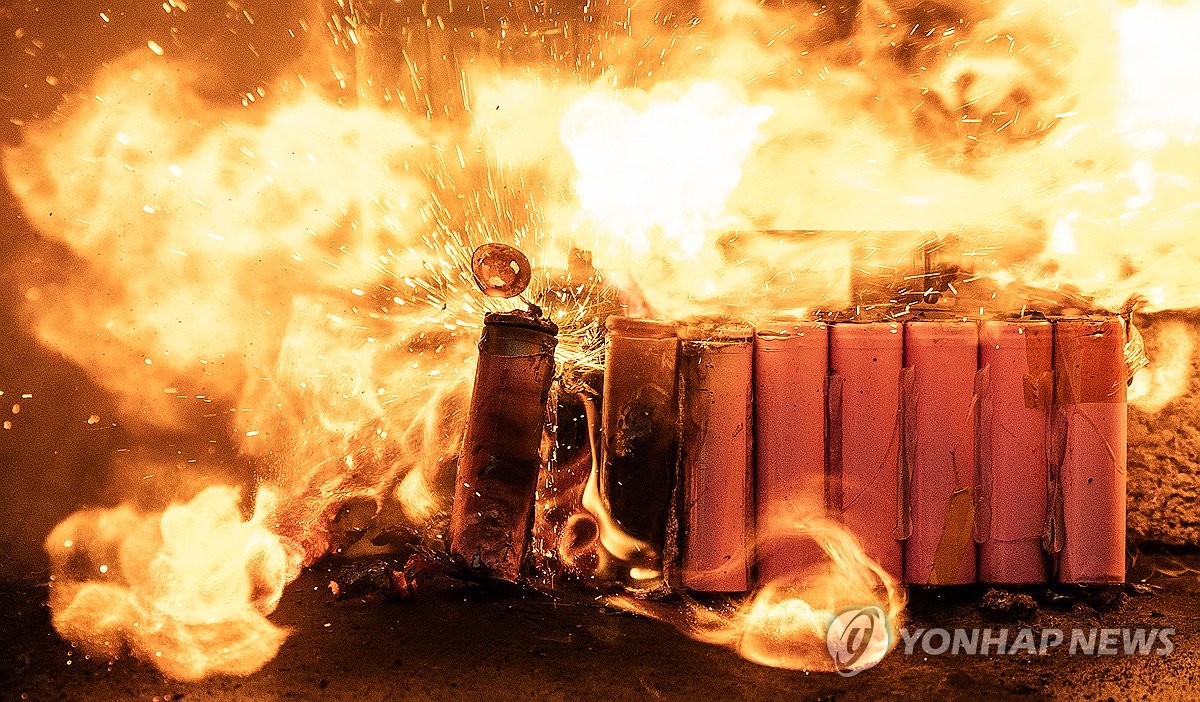
Responding to battery fires is expanding to unmanned reconnaissance. Thermal runaway, a major cause of such fires, is hard to detect in advance because voltage and temperature changes remain small until just before it happens. It is also difficult for people to enter first because remaining batteries can run away again even after flames are extinguished. The industry expects the response system to spread to battery cell plants, and adoption is likely to accelerate at overseas plants that are first to face foreign fire standards.
According to the industry, lithium battery fires begin before flames are visible. As abnormalities such as overheating or overcharging build up, electrolyte inside a cell decomposes and vapor, or off-gas, leaks out. If this continues, thermal runaway follows and smoke and flames appear. Existing safety management has been focused on this final stage.
Even when a battery management system (BMS) operates, voltage and temperature barely change until just before thermal runaway, so gas detectors that detect hydrogen respond only around the time thermal runaway begins. Remaining batteries can run away again even after a fire is put out, but there is no suitable way to check inside without sending people in.
The risk has appeared in actual accidents. A fire broke out in August at a finished-goods warehouse of a primary battery manufacturing plant in South Chungcheong Province. According to the National Fire Research Institute, about 210,000 military primary battery packs stored in the warehouse were the same model as in the June 2024 fire at the Aricell plant in Hwaseong, Gyeonggi Province. During the Aricell fire, a chain thermal runaway of lithium batteries burned the entire building and 23 workers died. The South Chungcheong warehouse contained the fire early thanks to a fire-resistant reinforced-concrete structure and fire walls, along with automatic dispersal extinguishers installed on each battery storage rack.
Because the flames were contained early, many of the battery packs remained unburned but exposed to high heat. Lithium cells that have absorbed heat can spread into secondary thermal runaway and chain explosions from a small impact or additional temperature rise. Fire authorities then had to block entry for two weeks after extinguishing the blaze and monitor the situation from outside the building. It prevented a complete burn, but the remaining batteries became a new risk.
The industry is widening safety detection to before a fire and after it is extinguished. In the pre-fire stage, sensors that detect off-gas are cited as an alternative. In tests by Sandia National Laboratories in the United States, a volatile organic compound (VOC) sensor that reacts to off-gas issued a warning 7.1 minutes before thermal runaway. A battery pack that cut off current as soon as the sensor reacted did not ignite and cooled down. In South Korea, a Hanyang University research team is seeking conditions to detect thermal runaway early through off-gas in pouch-type batteries, which lack a safety valve so gas does not leak out immediately.
After a fire is extinguished, robots inspect the site instead of people. A vine robot developed by the National Fire Research Institute and a research team led by Yoo Ji-hwan (유지환), a professor at the Korea Advanced Institute of Science and Technology (KAIST), was deployed to the South Chungcheong warehouse. There were concerns that wheeled robots or quadruped robots could trigger thermal runaway by stepping on batteries on the floor with their heavy metal bodies. The vine robot extends forward as its tube inverts when air is blown in, so it hardly presses on the floor. The robot entered through rooftop vents and gaps in the floor and sent real-time information on internal temperatures, battery deformation and signs of collapse.
The industry expects the trend of introducing off-gas detection and unmanned reconnaissance to spread to battery cell plants. Off-gas detection has shown effectiveness in slowly developing abnormal conditions such as overcharging and overheating, and the industry says it leaves significant room for application to factory facilities that handle cells in large volumes.
Overseas, off-gas detection is starting to be required in fire standards. According to Tfactory, U.S. property insurer FM Global revised its loss-prevention standard for lithium-ion energy storage systems (ESS) in January 2024 to automatically isolate an ESS if cell temperature rises or off-gas is detected. It separately defined hydrogen detectors as devices responsible for alarms and emergency ventilation after thermal runaway begins.
The U.S. National Fire Protection Association's communications facilities standard, NFPA 76, also requires devices to monitor electrolyte vapor release before thermal runaway for facilities of 20 kWh or more where batteries are densely arranged. This is seen as likely to speed adoption of off-gas detection first at overseas plants of South Korean battery companies that must consider both insurer standards and local fire standards. An industry official said, "Given the nature of cell plants, even a single thermal runaway can cause a fatal blow," and added, "Regardless of the speed of legislation, we are proactively pushing to upgrade our own standards to improve risk management efficiency relative to cost."
 Seok Dae-geon
d2dg@d-today.co.kr