
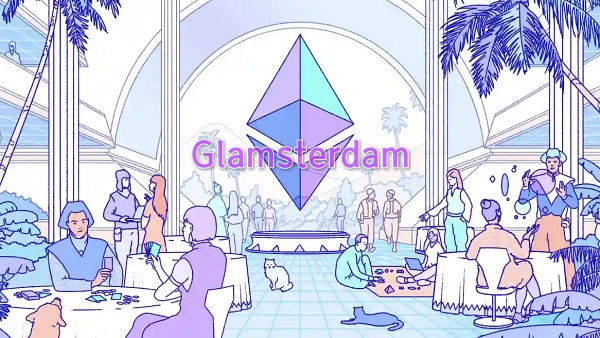
[Digital Today reporter Yoonseo Lee] Ethereum's next upgrade, 'Glamsterdam' (Glamsterdam), has entered its final stage.
On Sept. 27 (local time), blockchain media outlet U.Today reported that Ethereum Foundation researcher Tony Warshtetter (토니 바르슈테터) said Glamsterdam and EIP-7928 were nearing the final steps.
Testing continues on a developer network (devnet). The first public test, the Sepolia fork, is scheduled for Oct. 6, and the timing for mainnet application has been presented as the fourth quarter of 2026. No exact date has been disclosed.
This upgrade is focused on preparing Ethereum's next-generation scaling architecture. Its three key goals are improving processing speed, expanding network capacity and limiting database bloat. Block-level access lists, known as EIP-7928, were presented as an element to strengthen parallel processing.
Warshtetter said Glamsterdam would be one of the largest forks ever and would be worth it given the long development time. He explained it would significantly boost throughput by expanding parallel processing, and raise sync speed while simplifying procedures through snap v2. He added that compatibility with zkEVM, partially stateful nodes and inclusion lists was also being considered.
Another key element of the upgrade is ePBS. ePBS is a structure that revises block validation procedures, focusing on reducing trust assumptions. As a result, Glamsterdam is more about changing the network's processing structure itself than simply adding functions.
Ethereum co-founder Vitalik Buterin (비탈릭 부테린) also presented a direction for development after Hegota. He explained on X, formerly Twitter, the meaning of changes to be introduced starting with the fork after Hegota, and said Ethereum was evolving beyond a simple blockchain.
Buterin cited a draft long-term roadmap called 'Strawman' (Strawman) and said Hegota, scheduled for 2027, was likely to be the last general-purpose fork that could be understood even from a 2015 technical perspective. He said recursive STARK, automated formal verification and advanced consensus algorithms aimed at quantum resistance would become central after that.
He also said a structural transition that began with PeerDAS would become Ethereum's core narrative after Hegota. The ultimate goal is to build a high-security computing environment that lowers costs and strengthens scalability and privacy, namely a 'cryptographic world computer.'
In this 흐름, Glamsterdam is assessed as a major turning point for moving to the next stage. Immediate points to watch are whether the October Sepolia test and a mainnet rollout within the year proceed as scheduled, and whether parallel processing and a revamp of validation structures lead to actual network scaling.
Glamsterdam with EIP-7928 (Block-Level Access Lists) is approaching the final mile, and things look great: * Significant throughput increase thanks to parallelism * Faster and simpler sync via snap v2 * Future-compatible with zkEVMs, partially stateful nodes, inclusion lists,… https://t.co/XBcj9WOpaD
 Yoonseo Lee
yslee@d-today.co.kr
Yoonseo Lee
yslee@d-today.co.kr