
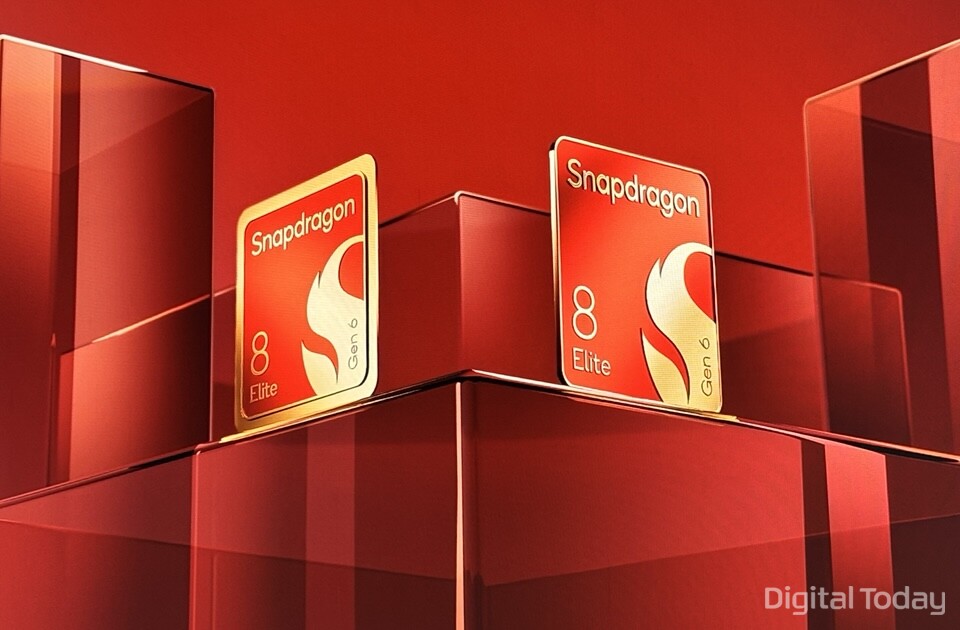
MAUI, Hawaii, Sept 22 - Qualcomm is supplying this year's flagship mobile platform split into two products with different dies and packages. It is a multi-flagship strategy aimed at letting smartphone makers (OEMs) pick only the functions needed for base, pro and ultra models and lower costs across the lineup. Qualcomm said 8K 60fps capture and the APV codec are included only in the higher-end Snapdragon 8 Elite Extreme 6th Gen.
With the two platforms, Qualcomm is giving phone makers the option to include costly functions such as 8K capture only in top models and remove them from lower models. Chris Patrick (크리스 패트릭), Qualcomm senior vice president and head of the mobile handset business, said in a Snapdragon Summit 2026 mobile Q&A session held on Sept. 22 local time in Maui, Hawaii, that instead of putting 8K60 into phones that do not need it, manufacturers can cut the average cost across their portfolios. He said that was the intent of the investment. He meant that if all functions are packed into a single platform, lower-end models also end up bearing the cost of functions they do not use.
He cited cases where manufacturers do not use the same camera sensor across base, pro and ultra models. They put a high-performance camera only in the top model and lower specifications in lower models to create price tiers. Consumers who do not place importance on the camera can buy the base model, and manufacturers can offer different prices and functions for different consumers.
Patrick described the two platforms, split into Elite and Extreme, as products with very different dies but the same family and the same DNA. The die refers to the chip body on which circuits are etched. The two products have exactly the same Qualcomm Oryon CPU design IP, but the GPUs share a similar design foundation while differing in expansion functions. Adreno high-performance memory (HPM) capacity, the matrix accelerator and the image signal processor (ISP) also differ.
Qualcomm: We will not include 8K60 in phones that do not need it
Judd Heape (쥬드 히프), Qualcomm vice president of product management, said 8K 60fps and 4K 240fps capture, the APV codec and the VVC decoder are only in the 8 Elite Extreme 6th Gen. Patrick said the intent is to deliver a true flagship experience even on the 8 Elite 6th Gen. He said that if users want even a single frame in games or professional content creation on a phone at a level nobody has tried, they can invest in Extreme.
The package that handles heat also differs between the two platforms. Qualcomm has used package-on-package (PoP), stacking memory on top of the chip, for the 8 series. In the Snapdragon 8 Elite Extreme 6th Gen, it applied an offset package that places memory on top of the chip but shifted to the side. Qualcomm said the placement changes the die's heat management method.
Patrick said it can sustain performance longer by drawing heat out of the die even when running games at high resolution and high frame rates. The Snapdragon 8 Elite 6th Gen uses the existing PoP package. Asked about the burden of rising memory prices, Patrick replied that the memory cost structure does not change because it uses a similar memory solution to the past.
The AI performance gap between the two platforms shows up when a smartphone is made to do multiple things at once. Vinesh Sukumar (비네시 수쿠마르), Qualcomm vice president of product management, said composite commands that tie multiple tasks into one instruction, such as 'Send me my plan for next summer vacation,' are increasing, and those tasks must be processed in parallel at the same time.
The Snapdragon 8 Elite Extreme 6th Gen has more scalar and vector threads responsible for parallel processing. Sukumar cited a case targeting 1 second from request to completion and said the 8 Elite 6th Gen could take about 1.2 seconds, about 20 percent longer. He added that in single tasks such as removing facial wrinkles in a photo, there is no difference between the two platforms. AI camera functions in which the NPU and ISP operate together are included in both platforms in the same way.
Manufacturers' choices are currently split. Patrick said Motorola has announced a device using the 8 Elite Extreme 6th Gen, while Xiaomi mixes the two platforms by tier. Some manufacturers that emphasize other values such as form factors use only the 8 Elite 6th Gen.
Asked which will become mainstream in this generation, Patrick said the story has not yet been written and he will not speak ahead of manufacturers' decisions. He said the company will continue supplying last year's Snapdragon 8 Elite 5th Gen to manufacturers sensitive to costs. Patrick said new transistors or codecs add costs, and keeping a previous platform alongside gives manufacturers more finely segmented choices.
 Daegeon Seok
d2dg@d-today.co.kr
Daegeon Seok
d2dg@d-today.co.kr