
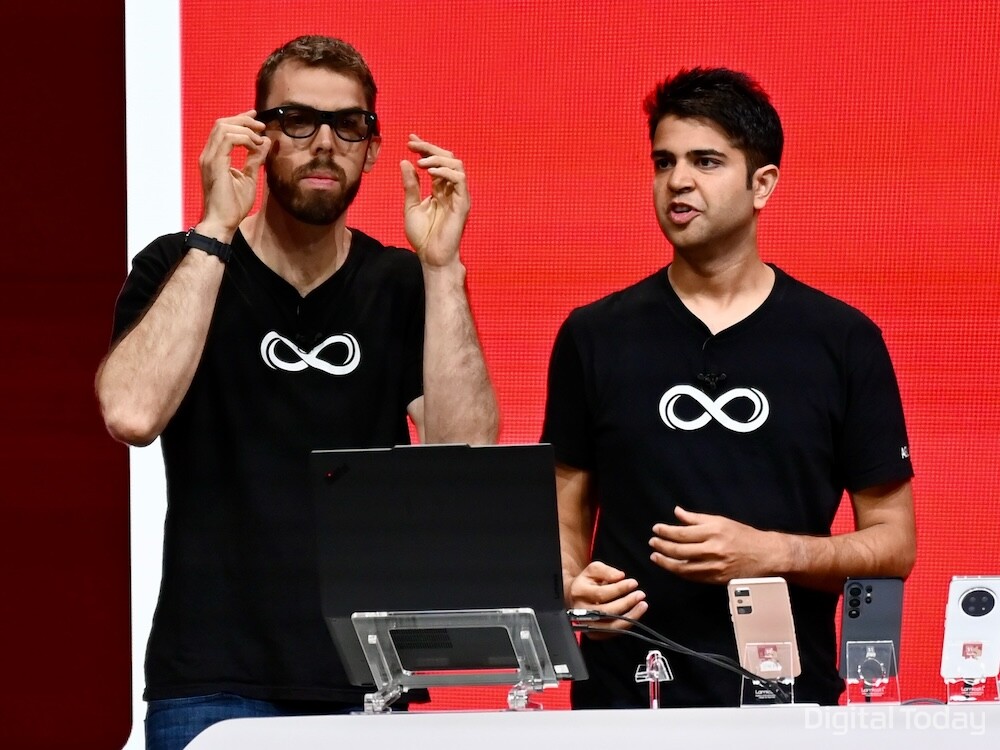
[Maui, United States = DigitalToday reporter Seok Dae-geon] Snapdragon partner companies are moving to target device makers with their own models and inference engines tailored to the Hexagon NPU (neural processing unit). Their plan is to supply agents that run on devices to smartphone, smart glasses and car makers, because running agents in the cloud incurs a cost per call and stops if communications are cut. According to Qualcomm, MemoriesAI runs its own 3 billion-parameter model for smartphones and 1.5 billion-parameter model for wearables on the Hexagon NPU.
AI agent companies AGI, LiquidAI and MemoriesAI introduced their on-device agent technologies on Sept. 24 (local time) at the Snapdragon Summit “Elite Experience” session in Maui, Hawaii. Steve Frey (스티브 프레이), co-founder and president of AGI, said, “We are working with Qualcomm to process more of the agent’s operation within the device.”
AGI’s product for device makers is a package of agent-dedicated software. Frey cited copying an address from a calendar app and pasting it into a ride-hailing app. He explained that an agent with access to device-wide context and apps handles such repetitive tasks.
Dhib Garg (디브 가르그), AGI’s chief executive officer, introduced an agentic OS stack built with the action model “AGI Act” and the company’s inference engine “AGI Arrow.” The model directly controls third-party apps installed on a smartphone without separate APIs or integration work. Targets include settings, ride-hailing, social media and shopping apps. Garg said it reflects what can be implemented with currently available silicon and first-generation on-device models, and will improve further.
Garg said, “We provide agents that act first to companies that make smartphones, cars, smart glasses and watches,” adding, “The AGI action layer is currently available on the Snapdragon platform.” He added, “If you are making devices or want to connect your products to apps on users’ devices, come find us.”
LiquidAI highlighted a model that reads the user’s real-world context. Jeffrey Lee (제프리 리), LiquidAI’s chief operating officer, described the company’s goal as “to build the most efficient foundation model that runs in real environments.”
In this structure, Qualcomm’s sensing hub provides a constant stream of signals on the device, and the Hexagon NPU uses those signals to create and update the user’s personal context on the device in real time. Lee said, “An agent that only reads messages and schedules is just guessing,” adding, “AI can help first without sending all of life’s context to the cloud.”
MemoriesAI supplies a memory layer that other agents can use. Shawn Shen (숀 셴), CEO of MemoriesAI, is developing an on-device perception vision-language model with Qualcomm. Shen explained, “Even if it is not our AI assistant, any agent the user uses can be personalised with this model.” He said a single Snapdragon-based model works across all devices a user carries.
Qualcomm is expanding this partner ecosystem. Vinesh Sukumar (비네시 수쿠마르), vice president of product management at Qualcomm who oversees its AI products, said the demonstration showed Snapdragon on-device AI can use context to take meaningful actions efficiently in terms of cost and power.
According to Qualcomm, it is building an on-device agentic stack with dozens of partners across models, memory, tooling, orchestration and governance. Sukumar said, “Agentic AI has received a positive response at an early stage, and we expect it to become established in earnest this year.”
 Seok Dae-geon
d2dg@d-today.co.kr
Seok Dae-geon
d2dg@d-today.co.kr