
[Maui, United States=DigitalToday reporter Daegeon Seok] Qualcomm filled a session explaining Snapdragon AI capabilities with demonstrations of partner services. It judged that boosting chip performance alone is not enough to build an on-device agent that remembers and understands users and acts on their behalf. It said software that gathers user context and turns it into action is also needed.
At the Snapdragon Summit “Elite Experience” session held on Sept. 24 local time in Maui, Hawaii, Judd Heape (저드 헤이프), vice president of multimedia product management at Qualcomm, said it was “a session to show experiences that use agentic AI and Snapdragon technology in new ways.”
Ahead of the demonstrations, Heape asked the audience whether they often film videos for work and whether they dislike selecting, categorising and editing footage. When many said they did, he said the demonstrations would show how to make that work easier.
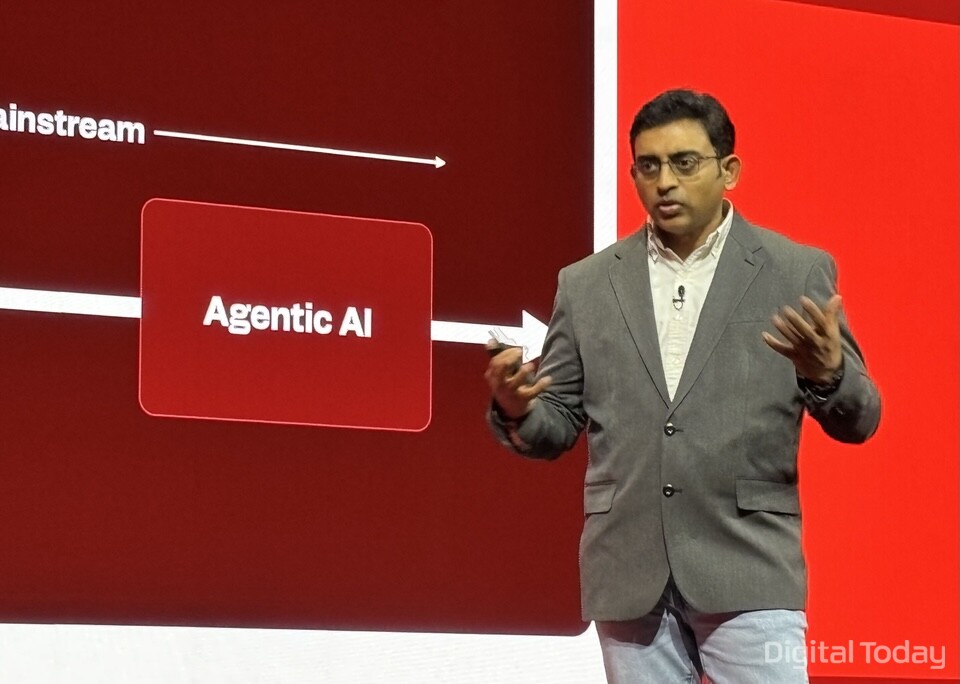
Vinesh Sukumar (비네시 수쿠마르), vice president for product management at Qualcomm, then said that while large models are expanding the capabilities of agentic AI, capability alone does not create personalisation. “Personalisation needs context,” he said, explaining why the company was demonstrating the technology.
Qualcomm presented a digital twin as its goal. Agentic AI must go beyond remembering and understanding users and take meaningful actions on their behalf. For example, a twin can be implemented only if a device builds a personal knowledge graph based on a user’s lifestyle patterns, preferences, routines and frequently visited places. “To personalise, AI must be able to imitate the user, and it needs the user’s digital twin,” Sukumar said.
For an on-device AI device to reach a twin-like state with a person, memory, judgement and action must be implemented as real services, a role that partner companies take on. The demonstrations showed scenes in which digital twins were realised in practice.
Memory was handled by memories.ai. Sean Shen (숀 셴), chief executive officer of memories.ai, introduced a service in which a smartphone collects daily records captured by smart glasses and a laptop and indexes them on-device. In one scene, after arriving in Hawaii, the user asked where to pick up a rental car and where the hotel was, and the agent immediately answered by recalling a laptop screen used to make reservations. Users can review accumulated memories in chronological order or through people and company relationship maps, and can delete unwanted memories immediately. “All processing happens on-device and no data ever leaves the device,” Shen said.
Judgement was shown by Liquid AI. Jeffrey Li (제프리 리), chief operating officer of Liquid AI, gave an example of injuring his knee while running on a beach. A smartwatch detected that running speed had dropped and that left-right gait was asymmetric, and a Personal Scribe running on a Qualcomm sensing hub recorded a mention of knee pain during a call. The agent linked these signals to first suggest cancelling the next day’s exercise schedule and drafted a text message to send to a friend who exercises with him.
Action was demonstrated by AGI. Dib Garg (디브 가르그), AGI CEO, gave a voice command to find a restaurant name mentioned in a morning conversation and send it to a group chat in a messenger app. The agent found the restaurant in the Personal Scribe record, opened WhatsApp and sent the message. Further demonstrations showed the agent finding and ordering headphones seen through smart glasses on Amazon, and taking a selfie in airplane mode and sending it by text message.
About 20 minutes of Sukumar’s roughly 33-minute presentation consisted of demonstrations. It is an assessment that Qualcomm is shifting the focus of AI from boosting chip performance to building usable services with partners. Sukumar closed the session by saying, “Qualcomm does not do this alone.”
 Daegeon Seok
d2dg@d-today.co.kr
Daegeon Seok
d2dg@d-today.co.kr