
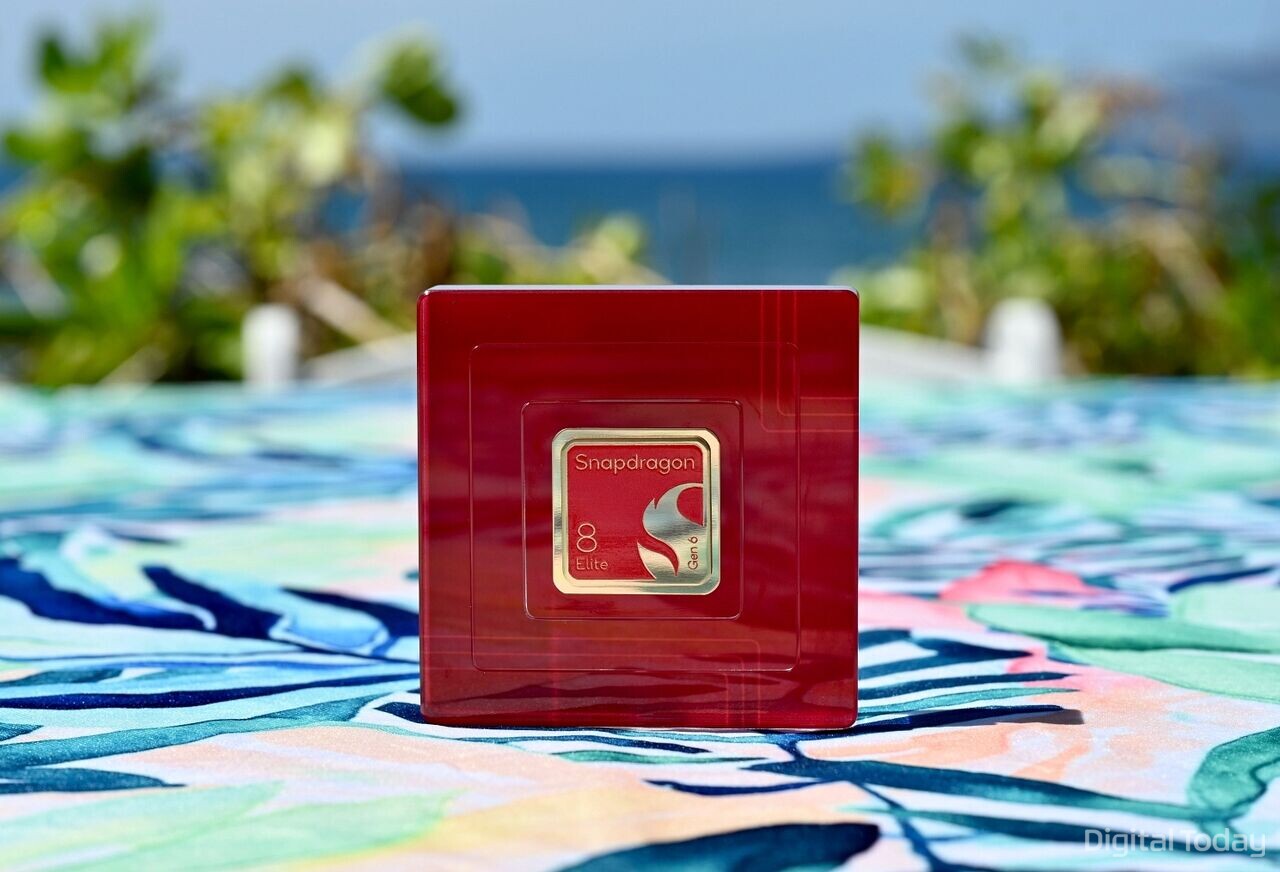
[Maui, United States=DigitalToday reporter Seok Dae-geon (석대건)] Benchmark scores for Qualcomm’s Snapdragon 8 Elite Extreme Gen 6 are coming in around the expected ranges presented by Qualcomm. In a benchmarking session at Snapdragon Summit, Qualcomm also disclosed a reference device and expected score ranges by benchmark, and had reporters measure results directly. CPU scores measured by the reporter were within 1 percent of Qualcomm’s stated lower bound.
The benchmarks were run on a Qualcomm Reference Design (QRD) device equipped with the Snapdragon 8 Elite Extreme Gen 6. Qualcomm said the QRD has a chip made on TSMC’s 2-nanometer process and 24GB of memory. Qualcomm’s guidance ranges are based on the average of three runs for each benchmark.
Geekbench 6.5 single-core scored 4,308, below Qualcomm’s stated lower bound. Multi-core and Geekbench 7.0 scores were also slightly below the lower bound. All differences were within 1 percent. Geekbench, which measures CPU performance, reports separate single-core and multi-core scores. A higher single-core score speeds up instant responses such as app launches and screen switching, while a higher multi-core score makes tasks such as video editing and running multiple apps at the same time easier. The fact that all items clustered below the lower bound may also reflect differences between the measurement conditions used to average three runs and the on-site conditions of continuous runs without breaks.
Speedometer 3.1, which measures web browser responsiveness, scored 60.8, exceeding Qualcomm’s stated upper bound. Speedometer measures how quickly a Chrome browser processes actions that operate web apps. The higher the score, the faster the response when pressing buttons and moving between screens on shopping sites or news sites. Speedometer was the only CPU-related test item that exceeded the upper bound. In web responsiveness, Qualcomm’s guidance appears to have been set conservatively.
Antutu v12, which measures overall device performance, took the longest to produce a result. Antutu aggregates CPU, GPU, memory and storage performance to show the device’s overall class like a comprehensive health-check score. The device became hot enough to make holding it uncomfortable after the test. The result fell slightly short of Qualcomm’s lower bound, but the gap was small and did not appear large enough to distinguish device class.
Gaming graphics performance was measured with 3DMark. 3DMark uses an offscreen method that renders internally at a set resolution without displaying on the screen, so scores are not capped by screen resolution or refresh rate. The device heated up again during repeated graphics tests and cooled down between measurements.
Steel Nomad, which renders high-end game scenes, and Solar Bay Extreme, a ray-tracing scene that calculates reflections and shadows realistically, came in within the expected range. Holding the expected range in heavy scenes is interpreted as supporting Qualcomm’s claimed GPU performance improvements.
Wild Life, which renders scenes at the level of mobile games, fell below the expected range. Wild Life Unlimited was about 8 percent below the lower bound, and Extreme Unlimited was about 2 percent lower. Because Wild Life renders scenes closer to typical mobile games, it appears necessary to verify on commercial devices whether this gap translates into real gaming experience.
◆Hard to judge performance from a single score..."Performance should be judged on commercial devices"
AI benchmarks measure how fast AI models run on a smartphone. The higher the score, the faster on-device AI functions such as photo search, document summarisation and translation without an internet connection. In AITutu, the CV item looks at computer vision that recognises objects in photos, while the LLM item evaluates large language models that generate sentences like a chatbot.
CV slightly exceeded expectations and LLM was within 1 percent of expectations. AI Mark VLM, which describes content after looking at images, scored in line with expectations. With AI items excluding AI Mark almost overlapping guidance, Qualcomm’s targets for AI performance were generally reproduced on site.
AI Mark showed the largest gap versus expectations among the AI items measured on the day. A Qualcomm official explained, "AI performance varies depending on end-to-end optimisation, software and the types of models being run, so it is not possible to fully verify platform improvements with benchmarks alone." Looked at the other way, it becomes difficult to draw conclusions about overall AI performance from a single benchmark.
Overall, Qualcomm’s expected ranges largely matched measured results, excluding Wild Life. Not every item met Qualcomm’s figures. Wild Life and AI Mark fell short of expectations, but this gap is also assessed as showing that it is difficult to draw firm conclusions about overall smartphone performance, including AI, from a single benchmark score. Qualcomm also stressed during the session that functions consumers actually use are more important than benchmarks.
Qualcomm also rolled out the Snapdragon 8 Elite Gen 6 this time and touted a multi-flagship strategy to broaden OEM options. The Snapdragon 8 Elite Extreme Gen 6 is expected to be used in flagship devices from major global OEMs and smartphone brands.
 Seok Dae-geon
d2dg@d-today.co.kr
Seok Dae-geon
d2dg@d-today.co.kr