
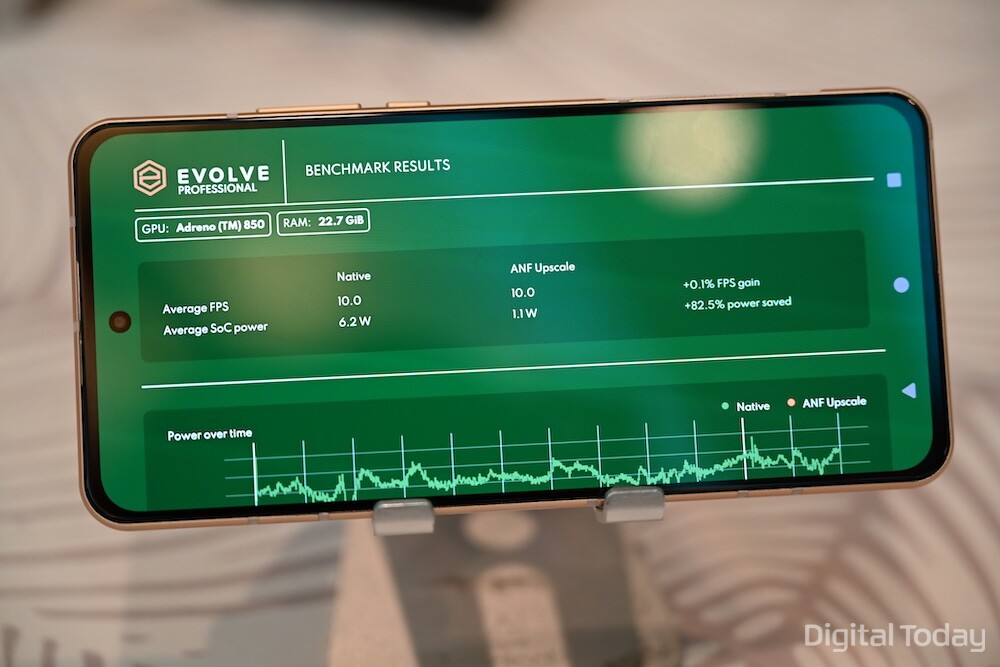
[Maui, United States = DigitalToday reporter Seok Dae-geon (석대건)] Qualcomm's Adreno Neural Fusion, which draws game screens with AI, also reduced power consumption for smartphone gaming. Qualcomm showcased a benchmark it developed itself in a benchmarking session at Snapdragon Summit 2026 and allowed participants to measure Neural Fusion's effect publicly. Under conditions with fixed frames, power consumption was 1.1W, close to Qualcomm's figure.
In the benchmarking session, Qualcomm unveiled a new benchmark called "Traverse Evolve" using a Qualcomm Reference Design (QRD) device equipped with Snapdragon 8 Elite Extreme Gen 6. A Qualcomm representative said, "You probably have not heard of it before," and introduced it as "a benchmark newly developed to show Neural Fusion features."
It alternates between a native mode that renders the same game scene without Neural Fusion and a Neural Fusion mode, comparing frame rate and power use. Power is measured with the screen fixed at 10 frames per second. Running Traverse Evolve, the native mode's average frame rate was 17.7 frames per second. Frame rate is the number of images that pass on the screen in a second, and the more images, the smoother the motion, like a flipbook.
Switching to ANF Upscale mode, the average frame rate rose to 49.2 frames per second. Both figures were slightly lower than the expectations Qualcomm presented in its guide. Neural Fusion combines super resolution, in which AI sharpens an image after rendering at a lower resolution, and frame generation, in which AI creates intermediate images between two frames. It is structured so the GPU does not have to draw every image from scratch.
Until now, mobile games have had to give up one of image quality, frame rate and battery life, and Neural Fusion was designed to lift that constraint. Qualcomm also explained it reduced problems in existing mobile upscaling in which fine details shimmered or fast-moving objects left trails. Higher frame rates reduce stutter in fast-moving games such as combat scenes.
◆Qualcomm: "Expanding matrix acceleration from NPU and CPU to GPU"
Power measurement compares how much electricity is used to render the same amount of images, similar to comparing fuel economy for cars driven the same distance. With both modes maintaining the same frame rate, native mode used an average of 6.2W, while ANF Upscale mode fell to 1.1W. Both figures were slightly higher than Qualcomm's expectations. Lower power consumption allows longer gameplay on the same battery. Qualcomm said, "The goal of Neural Fusion is to raise game graphic quality, run faster and use less power."
The benchmark app showed a power-saving rate of 82.5 percent, similar to Qualcomm's 81 percent. Qualcomm cited a structure in which AI computation and data are processed on the chip as the reason for the reduction. The Adreno Matrix Core is an AI-dedicated GPU core that runs AI models directly within the graphics processing pipeline. Adreno High-Performance Memory (HPM) stores intermediate calculation results on the chip. It is like keeping frequently used materials next to the workbench, reducing trips to a distant warehouse, or system memory.
It said there is no need to move data outside the graphics processing pipeline to run AI computation. A Qualcomm official explained, "If the number of data transfers decreases, latency is reduced, efficiency increases and gaming sessions get longer." The official added, "Benchmarks are only one means of showing upgrades and are not what consumers ultimately see," stressing real-world use environments.
Qualcomm said the introduction of the Adreno Matrix Core expanded matrix acceleration to the GPU after the NPU and CPU, and it expects this to be a turning point where the way AI is processed changes into a platform capability. There are 18 game titles currently expected to support Adreno Neural Fusion. Neural Fusion is already integrated into Unity and Unreal Engine, allowing game studios to apply it without developing separate features, and related development documents and plug-ins are currently being provided. Qualcomm stressed Neural Fusion is the first mobile AI super resolution technology of its kind supported by major game engines.
 Seok Dae-geon
d2dg@d-today.co.kr
Seok Dae-geon
d2dg@d-today.co.kr