
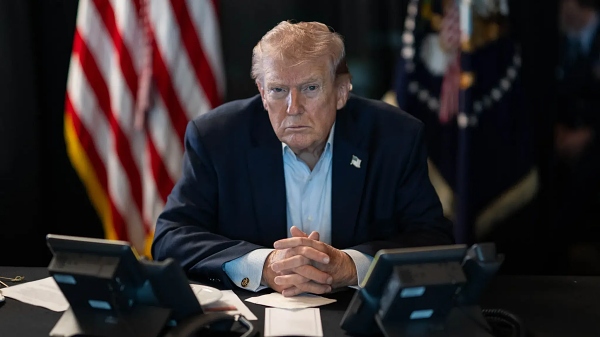
U.S. President Donald Trump said he will call artificial intelligence (AI) “super intelligence” from now on. He said the existing term “artificial” makes the technology sound fake. It remains unclear whether he can replace a term already widely used in the AI industry and academia.
On Sept. 22 local time, Trump said in a speech to the United Nations General Assembly that he would have the U.S. government label artificial intelligence as “super intelligence” in official documents, Business Insider and others reported. “If you use the word artificial, it makes the intelligence sound fake,” he said. “The actual AI technology is amazing,” he added.
Trump said all U.S. documents would use the word “super” instead of “artificial,” and that he hoped other countries would adopt the new name. He also stressed that AI development should not be restrained.
The remarks fall short of any step to change the official name of the technology internationally. “Artificial intelligence” is not a legal term set by a particular government, but a commonly used name for a technology field that industry, academia and consumers have used for decades.
The phrase “super intelligence” is also not newly coined. In the AI field, it is used to refer to systems that surpass humans in all intellectual abilities beyond general artificial intelligence. Calling all AI “super intelligence” could therefore be understood as different from existing technical concepts.
The term artificial intelligence dates back to the 1950s. A 1955 Dartmouth University research project proposal used the phrase “artificial intelligence,” and a research meeting held the following year helped it begin to take shape as an academic field. At the time, various labels were also used, including cybernetics and automata research, to address machine intelligence and autonomy.
The term AI later spread beyond academia across industry. Some companies, such as OpenAI, include AI directly in their names, while others use company-specific branding for AI, such as Apple’s “Apple Intelligence.”
An interpretation has emerged that Trump’s remarks are less about redefining AI itself than about stressing perceptions of the technology and the U.S. stance on AI development. In the same speech, he opposed moves for international controls on AI and said the United States should continue to lead technology development.
Debate continues over AI risks. Trump has dismissed warnings that AI could threaten humanity and has said he opposes approaches that slow technological progress. Some European countries and parts of the AI industry, by contrast, have called for international cooperation on safety issues involving advanced AI.
Whether “AI” will actually be replaced by the name “super intelligence” is a separate matter from changes in how U.S. government documents label it. With industry and academia continuing to use the existing term, it remains to be seen whether the remarks will become a catalyst for changing the global technical term itself.
 Jinju Hong
hongjj@d-today.co.kr
Jinju Hong
hongjj@d-today.co.kr