
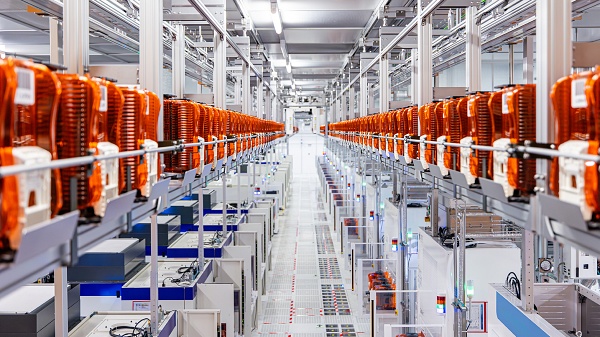
Even if a slowdown in artificial intelligence (AI) investment becomes reality, semiconductor foundries in the Asia-Pacific region could withstand a relatively bigger shock than other technology hardware segments, an analysis showed. Even if the AI investment cycle turns down in the short term, foundries' business structures and competitiveness in advanced processes could provide a buffer.
A report by S&P Global Ratings, cited by the South China Morning Post in Hong Kong on Sept. 18, said foundries were assessed as having the strongest defensive capacity against an AI investment slowdown among Asia-Pacific technology hardware segments.
S&P analysed downside scenarios for AI investment across four core segments: foundries, memory makers, cooling component suppliers and server assembly original design manufacturers (ODMs).
The analysis assumed two situations. One is that major hyperscalers such as Amazon and Microsoft reduce capital expenditure. The other is that AI projects are delayed by infrastructure bottlenecks such as power grid constraints or a lack of data centre sites.
In both scenarios, foundries were classified as the most resilient segment. Because they manufacture chips on contract designed by chip designers such as Nvidia, S&P judged that even if AI-related investment slows temporarily, the direct impact could be relatively limited.
In particular, TSMC, the world’s largest foundry, was assessed as having strong defensive capacity based on its lead over rivals in advanced manufacturing processes. Even if demand for high-performance semiconductors for AI is adjusted somewhat, demand for advanced processes and technological competitiveness could support the stability of the foundry business, the report said.
In the Asia-Pacific foundry market, TSMC and Samsung Electronics are forming a leading group, while Chinese companies are also expanding market share. TrendForce said that in the second quarter this year, China’s SMIC and Huahong Group ranked third and sixth, respectively, in global foundry revenue.
By contrast, S&P said memory companies could respond more sensitively to an AI investment slowdown. If AI-related demand peaks faster than expected, memory makers such as Samsung Electronics and SK Hynix could face greater pressure on prices and profitability.
Clifford Kurz (클리퍼드 커츠), an analyst at S&P, assessed that Asia-Pacific technology hardware companies have sufficient buffers to respond to delays in AI spending plans. He warned, however, that credit risks could rise over the longer term if AI demand itself moves in a different direction than expected.
The analysis comes as market caution grows over whether enthusiasm for AI investment can persist for a prolonged period. Recently, Anthropic Chief Executive Dario Amodei (다리오 아모데이) also made a proposal aimed at slightly slowing the pace of AI performance improvement and strengthening safety devices.
Concerns about an AI investment slowdown are growing, but related funding has not fallen sharply. Moody’s forecast early this month that capital expenditure by major Chinese technology companies would total about $140 billion this year, more than doubling from $65 billion in 2025. It expected the figure to rise to about $165 billion in 2027.
In the United States, AI-related investment by major big tech companies is also continuing on a large scale. Combined capital expenditure this year by Microsoft, Amazon Web Services, Alphabet, Meta Platforms, Oracle and AI cloud company CoreWeave is forecast to exceed $785 billion, and is expected to approach $1 trillion in 2027.
S&P also maintained its existing forecast in its base scenario that demand across the AI value chain would remain strong over the next two years. It allows for the possibility of short-term investment adjustments, but it does not see the entire AI supply chain entering a sharp downturn.
Separately, the possibility was raised that China’s AI infrastructure investment could be concentrated in some major cities. In another report, S&P forecast that Shanghai, Beijing, Shenzhen and Hangzhou would be major beneficiaries of AI infrastructure expansion based on their research talent, engineering capabilities and capital capacity. Benefits could be concentrated in areas with a foundation to accommodate companies that can build related infrastructure and services, while other regions could be left waiting for spillover effects later, the report said.
In Shanghai’s case, the foundation for advanced industries such as semiconductors and AI is already expanding. Official statistics show Shanghai’s three major advanced industries — integrated circuits, biomedicine and AI — have exceeded 2 trillion yuan in size, and the semiconductor industry accounts for about one-third of China’s total.
Ultimately, the key point of the analysis is that even if an AI investment slowdown becomes reality, Asia-Pacific technology hardware segments will not take the same hit. Foundries show relatively high defensive capacity based on advanced processes and a diversified customer base, while memory, server assembly and cooling component companies may respond more sensitively to the pace of AI investment and the state of data centre construction.
If AI demand is sustained over the long term, growth in related segments could continue, but if the investment cycle is adjusted more sharply than expected, differences in performance and credit strength by segment are expected to become more pronounced.
 Jinju Hong
hongjj@d-today.co.kr
Jinju Hong
hongjj@d-today.co.kr