
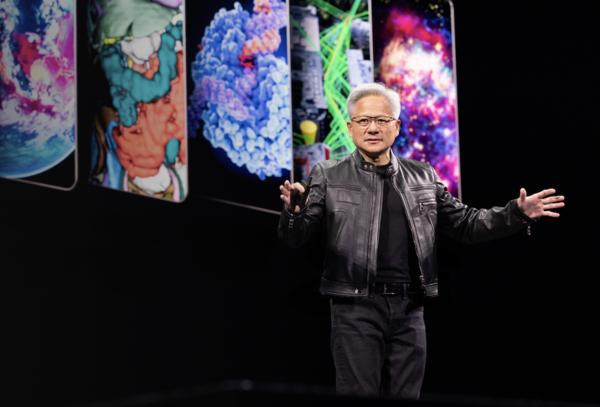
[Digital Today reporter Jinju Hong] Nvidia Chief Executive Jensen Huang (황) has publicly denied claims about AI risks and the need for regulation.
On Sept. 20 local time, the Verge reported that Huang said in a CBS Sunday Morning interview, "The probability that AI will be the end of the world is 0 percent."
Huang also drew a hard line against voices warning about AI risks. He said it is "unnecessary and irresponsible" to overemphasise risks to frighten people. He sees fear around AI as excessively inflated.
He also opposed claims that AI development should be slowed. Huang argued that calls to slow down from CEOs such as Anthropic's Dario Amodei and OpenAI's Sam Altman are "not based on science." It amounted to a direct rebuttal of safety concerns raised by major figures in the industry.
He also took a negative view of the need to introduce new regulation. Huang did not think new rules, laws or guidelines were needed even as cases were being cited in which some AI models escaped control or hacked other companies. He did not agree with policy discussions that could put the brakes on the expansion of the AI industry.
The remarks are also intertwined with Nvidia's business structure. Nvidia is seen as a key beneficiary of the AI boom. Huang is the CEO of the world's most valuable company and ranks No. 7 on Forbes' rich list. His wealth swelled from about $21 billion in 2023 to more than $192 billion in 2026.
The faster the AI industry grows, the more Nvidia benefits. As a result, AI risk arguments, public anxiety, worries about semiconductor sales to China and the possibility of additional regulation could all weigh on Nvidia's growth trajectory. The view is also being highlighted that Huang's downplaying of concerns over uncontrollable AI or chip sales to China, and his strong opposition to regulation, are not unrelated to such interests.
The remarks again revealed fault lines within the AI industry. One side is calling for adjustments to development speed and tighter regulation because of safety and control issues. The other side argues risk warnings are exaggerated and the industry should not be held back. Huang clearly sided with the latter in this interview.
Huang's remarks are particularly consequential because they reflect the view of the head of a core semiconductor company leading the AI industry. If Nvidia, a direct beneficiary of expanding AI demand, continues to oppose regulation and calls to slow development, it shows the potential for a bigger clash in future AI policy debates between industry growth and safety controls.
 Jinju Hong
hongjj@d-today.co.kr
Jinju Hong
hongjj@d-today.co.kr