
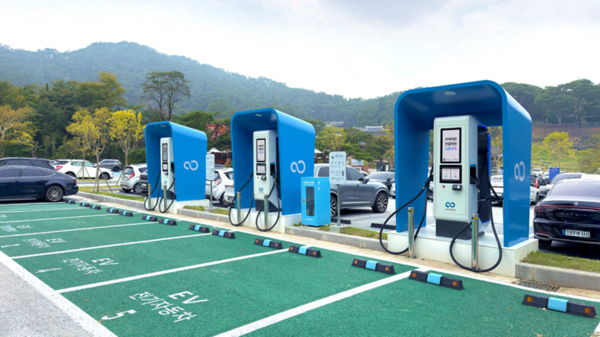
As a pilot rollout of plug-and-charge (PnC) begins mainly at public fast chargers at highway rest stops, competition between automakers and charging operators is intensifying over EV charging customers. Separate membership authentication systems used by each charging operator will be tied into a single unified authentication system, and membership card-based charging is losing ground. That is expected to fuel tougher competition as companies seek to secure customers beyond payment.
The Ministry of Climate, Energy and Environment will pilot PnC from September, focusing on public fast chargers at highway rest stops, after working-level talks and technical verification with the Korea Environment Corporation and Hyundai Motor Group. The ministry held a public hearing in March to gather opinions and has prepared to prioritise PnC adoption this autumn.
At present, EV charging requires 5 to 6 steps, including authentication via a membership card or smartphone app, selecting a charger and setting an amount or time. Because membership authentication differs by charging operator, drivers have carried separate roaming cards that allow them to use chargers from multiple operators with a single card.
At pilot chargers that apply PnC, plugging in the connector triggers encrypted authentication between the vehicle and the charger. Authentication, charging and payment then finish automatically without separate membership cards or credit cards. Authentication between the vehicle and the charger uses a digital certificate and encryption keys.
PnC has not spread because authentication methods differed by manufacturer and charging operator. Hyundai Motor Group has operated PnC certificates since 2021, but the scope of application has been limited. Last July, Hyundai Motor Group signed a memorandum of understanding with the ministry and the Korea Environment Corporation and agreed to transfer the certificate and issuance authority to the ministry free of charge. The Korea Environment Corporation will build a government-integrated authentication system based on this, and the ministry will manage and support its operation. As authentication is unified, membership cards issued by each charging operator will have less room to survive.
Card-free payment has also served as a differentiator for some charging operators. Bright Energy Partners' EV charging business unit, Water, provides an integrated payment environment that allows charging without entering separate payment information. Under unified authentication, charging and payment will be completed with the same certificate regardless of which operator's charger a driver plugs into.
◆ Authentication and payment without human input... PnC can also be applied to robot charging
As card-free payment becomes a common function across all chargers, companies are expected to compete to attract customers using their respective strengths.
Automakers are seeking to secure customers with vehicles equipped with PnC. Hyundai Motor Group has handed certificate issuance authority to the government, but PnC technology remains installed in its vehicles. PnC works only if a certificate is stored in the vehicle. Hyundai Motor Group has operated the certificates directly since 2021 and has also built authentication technology between vehicles and chargers.
With this cooperation, not only Hyundai, Kia and Genesis but also domestic and imported EVs equipped with PnC and a range of charging operators are expected to be able to use a standardised authentication system. The decision to transfer authentication authority to the government is also seen as a choice aimed at increasing the number of chargers that can support PnC charging for its vehicles.
Charging operators are expanding their businesses from charger manufacturing to charging-station operations. According to Hana Securities, Lotte Innovate subsidiary EVSIS has stressed business expansion that takes on overall outsourced operation and management of charging stations, and market leader Chaebi in the fast-charging market generates half of its revenue from manufacturing and half from operations.
SK Signet, which has mainly manufactured and supplied chargers, also hired personnel in the first half to handle charging point operator roles to run the charging business at highway rest stops nationwide. The posting lists applying for and operating government subsidy programmes and supporting customer service at charging stations as key duties, and says experience in business partnerships and business-to-consumer services is preferred.
Until now, SK Signet has mainly supplied chargers and operating platforms to other charging operators. It had a division-of-labour relationship with group charging point operator SK ElecLink, but it has become a competitor. As it becomes harder to differentiate through payment methods, charging operators are seen as trying to secure customers through charging-station operating capabilities.
The pilot programme has started only at some chargers at highway rest stops, but there is an assessment that when robots reach commercialisation, companies that first secure charging authentication and payment methods will be able to expand their business. PnC allows devices and chargers to handle authentication and payment without human input. An industry official said, "Competition for leadership in PnC goes beyond changing how EVs are charged, and can even be seen as competition over future mobility communications networks that combine autonomous driving and robot ecosystems."
 Daegeon Seok
d2dg@d-today.co.kr
Daegeon Seok
d2dg@d-today.co.kr