
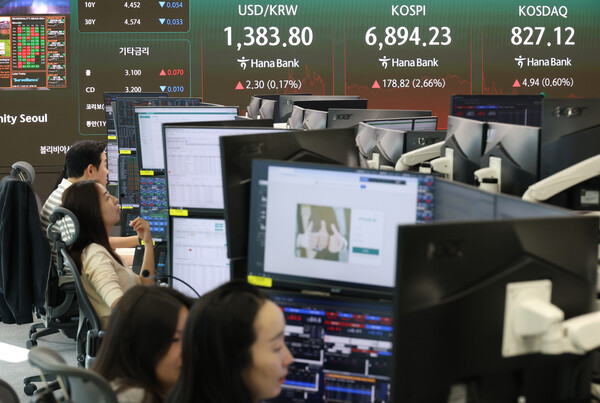
South Korea's stock market is expected this week to digest interest-rate trends after the U.S. Federal Open Market Committee (FOMC) and shifts in supply and demand ahead of the Chuseok holiday. Despite hawkish monetary policy, long-term interest rates have been stable, and earnings linked to semiconductors and artificial intelligence (AI) are expected to support the downside of the index.
The KOSPI fell 2.8 percent last week, while the Kosdaq rose 0.2 percent. The key variable weighing on stocks was interest rates. At the September FOMC, the U.S. Federal Reserve raised its benchmark rate by 0.25 percentage point to 3.75 to 4.00 percent. Its dot plot also raised rate projections for this year and 2027, leaving room for additional tightening.
Still, the stock market reaction differed from the past. Despite the rate hike and a hawkish dot plot, long-term Treasury yields fell instead. That prompted assessments that uncertainty over monetary policy had eased to some extent. The move is seen as reflecting that markets had priced in much of the possibility of additional rate hikes and that the policy path ahead has become clearer than before.
The industry expects the market's direction ahead is also likely to be driven more by the level of long-term interest rates than by the benchmark-rate decision itself. If long-term yields surge again on rising inflation and international oil prices, it would weigh on valuations of growth stocks. If rates stabilise at current levels, pressure from the discount rate, which had widened earlier, could ease gradually.
Corporate earnings are a pillar for the market. Global hyperscalers and semiconductor companies that have reported earnings since September have confirmed that demand for AI infrastructure and memory remains solid. Recent share price corrections are also analysed as being driven relatively more by valuation declines due to high interest rates than by the earnings themselves.
Semiconductors are also likely to retain their position as mid- to long-term market leaders. Shares have recently come under pressure, but expectations for investment in AI data centres and improving memory conditions remain. Machinery, shipbuilding and construction, along with semiconductors, are also being cited as sectors of interest tied to the value chain connected to AI infrastructure.
Still, a gap in flows ahead of the Chuseok holiday is expected to be a variable this week. Investors typically adjust positions conservatively ahead of a long holiday, which can reduce trading value and increase short-term volatility.
Over the past 10 years, the KOSPI fell an average of 0.42 percent over the five trading days ahead of the Chuseok holiday, but rose an average of 0.68 percent in the five trading days after the holiday. That reflects a tendency for precautionary selling to emerge just before the holiday and for sidelined funds to flow back in afterward.
The Kosdaq also needs to be checked for the possibility of sector rotation. In a high-rate environment, buying is unlikely to spread across growth stocks overall. If rates do not rise further, rebounds could appear in smaller growth stocks that fell sharply, led by names showing improving earnings.
The market expects a period to continue in which investors weigh earnings and valuations by individual stock rather than betting on the entire index. The KOSPI has recently been moving more sensitively to rate changes than to corporate earnings forecasts. That raises the likelihood of widening differentiation around stocks with solid earnings and reduced price 부담.
Ultimately, this week's market will hinge on whether U.S. long-term interest rates can remain stable after the FOMC and how smoothly it passes through the pre-Chuseok gap in flows. If rates do not jump further and expectations for AI and semiconductor earnings hold, the market could try to rebound again after a pre-holiday pullback.
Donggil Roh (노동길), a research fellow at Shinhan Investment Corp, said, "The market is in a phase where direction is determined by the discount rate rather than earnings." He added, "Core leading stocks are still the existing leading sectors including AI infrastructure and semiconductors."
Kyeong-min Lee (이경민), a researcher at Daishin Securities, mentioned the possibility of higher short-term volatility due to a pre-holiday gap in flows, but said, "Volatility before and after the holiday can be used as an opportunity to increase weighting."
Jong-min Kim (김종민), a senior research fellow at Samsung Securities, described the current market as "the time for a first entry out of three stages for a buying point." He added, "It is time to prepare for upside risks that are coming rather than being swept up by fear of downside."
 Sangyeop Oh
yub@d-today.co.kr
Sangyeop Oh
yub@d-today.co.kr