
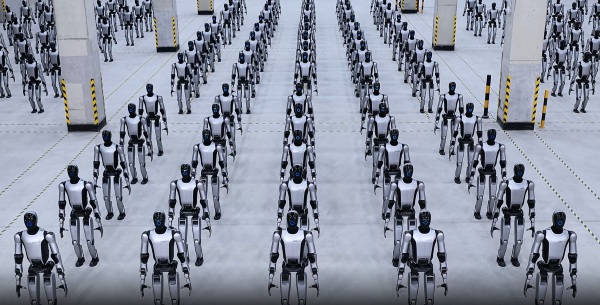
China's UBTech has started operating a smart factory that can produce 1 humanoid robot every 10 minutes. The plant aims to build production capacity of 10,000 units a year and has set up a system in which robots make robots.
On Sept. 18, TechRadar reported that the plant was built in Liuzhou in China's Guangxi Zhuang Autonomous Region and will produce UBTech's Walker S and Cruiser series. The factory covers 14,000 square meters, and UBTech describes it as the world's first smart factory dedicated to humanoid robots.
The way the factory is run also stands out. Humanoid robots and autonomous guided vehicles have been deployed on the production floor. Cruiser Y1 and Cruiser S2 handle unloading, loading and transport of materials. Final assembly uses collaborative robots, remote-control equipment, autonomous guided vehicles and 360-degree rotating worktables, and in some processes workers and robots work together.
Completed robots undergo more than four hours of comprehensive testing and then receive a 360-degree exterior inspection in an inspection tunnel at a level used for automobile manufacturing. UBTech manages the entire process digitally, from production through quality inspection.
UBTech has also built what it calls the industry's first fully automated three-dimensional warehouse. The facility can store 112 robots in a 65-square-meter space, and the company said space utilization is more than 50 percent higher than in a typical facility of the same size. Automated guided vehicles and unmanned forklifts handle logistics across production, inspection and storage.
UBTech cited China's supply-chain capabilities as a factor behind building such a production system. Fang Jianxin (팡젠신), a UBTech vice president, said engineers and scientists accumulated in China over the past 10 to 20 years and application scenarios have led to a strong supply-chain base, manufacturing capabilities and research and development capabilities.
Robot production in China is also rising. According to China's National Bureau of Statistics, output of industrial robots in July 2026 rose 30.2 percent from a year earlier to 98,677 units. Cumulative output for January to July 2026 increased 28.5 percent from a year earlier to 635,056 units.
Examples of using robots to produce robots are also continuing. After 1X disclosed its robot production process, China's Agibot also moved to expand production. Agibot said A3 Ultra said it is "moving from mass production to the stage of deployment in real sites" and released videos of it being operated at hotels, car dealerships, supermarkets and subway inspection sites.
UBTech's smart factory shows the humanoid robot industry is expanding beyond research and development and prototype production into a stage of building manufacturing infrastructure for mass production. In particular, with humanoid robots directly deployed in the production process, the level of automation in robot manufacturing and the scale of real-world deployment are emerging as key areas of interest.
 Seung-a Yoo
ysah@d-today.co.kr
Seung-a Yoo
ysah@d-today.co.kr