
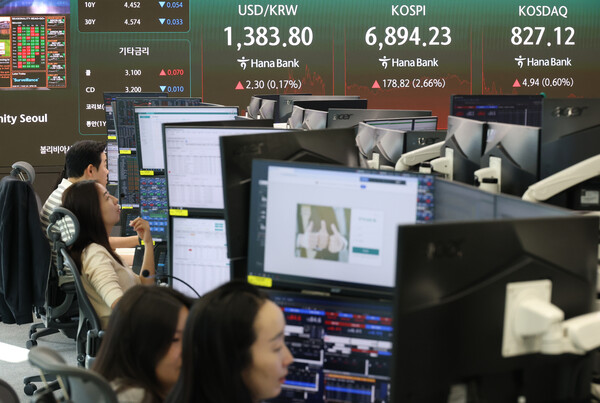
[DigitalToday reporter Oh Sang-yup] South Korea's KOSPI on Thursday rose more than 2 percent, supported by strength in heavyweight semiconductor shares and joint buying by foreigners and institutions. It recovered the 6,900 level during the session but gave up part of its gains to finish around 6,890.
According to the Korea Exchange, the KOSPI ended at 6,894.23, up 178.82 points, or 2.66 percent, from the previous session.
The KOSPI opened at 6,885.70, up 170.29 points, or 2.54 percent, from the previous session. It trimmed gains to as low as 6,830.95 but buying returned and pushed it up to 6,914.08, back above 6,900.
In the main bourse, foreigners and institutions were net buyers of 424.5 billion won and 1.5 trillion won, respectively. Retail investors were net sellers of 3.59 trillion won.
Semiconductor shares led the rise. Samsung Electronics closed up 3.37 percent at 261,000 won and SK Hynix jumped 6.42 percent to 1,857,000 won.
SK Square rose 7.04 percent, Samsung Electro-Mechanics gained 4.36 percent, Hyundai Motor added 0.55 percent and Samsung Biologics edged up 0.14 percent.
LG Energy Solution fell 0.27 percent, while KB Financial Group dropped 2.40 percent and Samsung C&T slid 1.27 percent.
The Kosdaq also rose. It ended at 827.12, up 4.94 points, or 0.60 percent, from the previous session.
In Seoul's foreign exchange market, the won fell 0.90 won, or 0.07 percent, to 1,382.90 per dollar from the previous session.
With the KOSPI recently swinging sharply around 7,000, buying returned on the day, led by heavyweight semiconductor shares, helping recoup earlier losses. Foreigners, who had recently continued selling, turned to net buying, easing some supply-and-demand pressure.
The brokerage industry sees recent foreign selling as largely short-term risk management to respond to external uncertainty such as the U.S. Federal Open Market Committee, rising long-term yields and the situation in the Middle East, rather than deterioration in domestic corporate earnings or the semiconductor outlook.
Han Ji-young (한지영), an analyst at Kiwoom Securities, said, "Macro uncertainty has passed its peak around the September FOMC," and "with more weight on the possibility of a return to net foreign buying, it is necessary to maintain the allocation to domestic stocks centered on key sectors such as semiconductors."
He also said the won-dollar exchange rate is unlikely to enter a sustained decline, which could ease stock-price pressure stemming from concerns over downward revisions to profit estimates for major export sectors such as semiconductors, shipbuilding and defense.
 Oh Sang-yup
yub@d-today.co.kr
Oh Sang-yup
yub@d-today.co.kr