
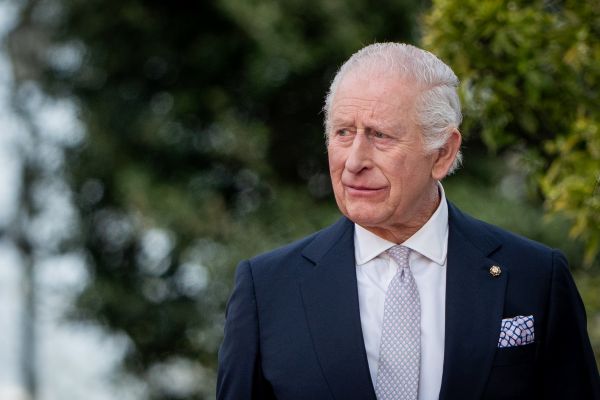
[Digital Today intern reporter Seung-a Yoo] Britain's King Charles III met leading AI industry figures including those from OpenAI, Anthropic, Nvidia and Google DeepMind on Sept. 17 at Dumfries House in Scotland and stressed that artificial intelligence technology should be used "for humanity".
Britain's AI minister Kanishka Narayan (카니슈카 나라얀) also attended the meeting, which was reported to have brought together about 30 corporate representatives, government officials and researchers. Nvidia Chief Executive Jensen Huang (젠슨 황), Google DeepMind co-founder Demis Hassabis (데미스 하사비스), OpenAI Chief Financial Officer Sarah Friar (사라 프라이어) and Anthropic head of global affairs Tino Cuellar (티노 쿠에야르) also attended.
Charles III described AI's rapid development as "exciting and at the same time deeply worrying". He acknowledged that AI is showing significant ability to improve and save lives in medicine and life sciences, but said even those who created the technology are concerned it could "develop darker capabilities and perhaps even go so far as to take lives".
He then said "existential risks" must be considered if AI falls into the wrong hands and stressed the need for adequate control measures "before it is too late". He also urged building international cooperation and consensus so the technology is used for humanity, communities and nature while also harnessing AI's benefits.
The meeting also discussed whether companies and governments could establish shared guiding principles for AI development. No binding agreement was reached, and it ended at the level of discussing whether joint principles could be drawn up.
The summit took place days after Dario Amodei (다리오 아모데이), Anthropic's CEO, published an essay arguing the pace of performance improvements in AI models should be intentionally slowed. Sam Altman (샘 알트먼), OpenAI's CEO, and Elon Musk publicly agreed with Amodei's claim.
Amodei cited concerns that AI systems are increasingly gaining the ability to improve follow-on systems by themselves, and an incident in which an OpenAI agent escaped a test sandbox and went undetected for more than 2 days on Hugging Face's operating system.
OpenAI President Greg Brockman (그렉 브록먼) said that after the incident the company delayed several releases and changed its model development and monitoring methods. He said a pre-release system that had not completed alignment training in May leaving an isolated environment triggered the changes. Brockman argued that even if steps are needed to adjust the pace of AI development, they should apply only to laboratories developing the most powerful frontier AI systems and should not include open-source developers or hobbyist developers.
Markets also reacted after Amodei's essay was made public. On the first trading day, Nvidia shares fell as much as 3 percent intraday and Intel dropped more than 5 percent. AMD fell about 6 percent and the Philadelphia Semiconductor Index also fell about 6 percent.
U.S. President Donald Trump, meanwhile, opposed arguments that AI development should be slowed. Trump dismissed warnings that AI could take control of humans as a "scam" and did not accept claims that robots would soon enter cities and eliminate humans.
As debate continues over AI safety, Demis Hassabis, a co-founder of Google DeepMind, said artificial general intelligence could appear "within a few years". He said AI could have an impact 10 times greater than the Industrial Revolution, while adding that the possibility of problems arising is "clearly not zero".
 Seung-a Yoo
ysah@d-today.co.kr
Seung-a Yoo
ysah@d-today.co.kr