
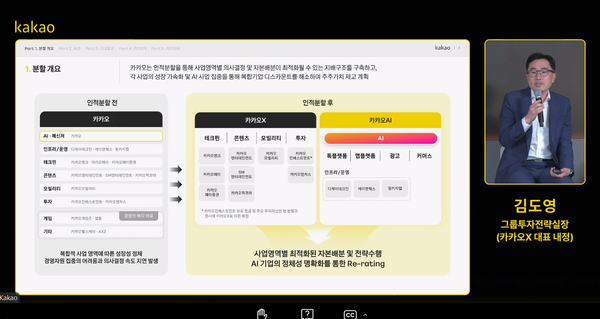
Kakao is working to persuade retail shareholders ahead of its planned corporate spinoff. KakaoAI will start monetising AI services from 2027 and generate more than 1 trillion won in AI revenue in 2030, while KakaoX plans to build a structure to return investment gains to shareholders.
KakaoX plans to buy back and cancel treasury shares worth a total of 300 billion won over three years after the split, using gains from selling its stake in Dunamu as the funding source.
Kakao held an online shareholder meeting for retail investors on Tuesday afternoon to explain the rationale for the spinoff, the two companies' growth strategies and shareholder return policies. Attendees included Kim Do-young (김도영), head of Kakao's Group Investment Strategy Office and the designated CEO of KakaoX, and Chief Financial Officer Shin Jong-hwan (신종환).
Kakao is pursuing a corporate spinoff to split into continuing company KakaoX and new company KakaoAI. KakaoX will oversee tech-fin, content, mobility and investment businesses, while KakaoAI will handle advertising, commerce and AI businesses centred on platforms including KakaoTalk and Kakao Map.
The plan must be approved at an extraordinary general meeting of shareholders on Dec. 17. If approved, the split is scheduled for Jan. 1, 2027, with plans on Jan. 27 of the same month to proceed with a change of listing for KakaoX and a relisting for KakaoAI.
KAKAOAI TO MONETISE FROM 2027; 1 TRILLION WON AI REVENUE IN 2030
One pillar Kakao presented on Tuesday was KakaoAI's growth and monetisation plan.
Kakao aims to secure 5 million monthly users for AI services within KakaoTalk this year. At its developer event, 'if(kakao)26', in October, it plans to demonstrate an agent AI service under preparation. It then plans to start monetising AI services from 2027 and expand AI's share of revenue in KakaoTalk-based businesses to double digits in 2028.
By 2030, Kakao aims to increase KakaoAI's total revenue to more than 6 trillion won and generate more than 1 trillion won of that from AI. It also aims to raise daily AI users to more than 20 million by that time and increase time spent on KakaoTalk by more than 50 percent from current levels.
Kakao cited a re-rating as an AI company and improved decision-making efficiency as reasons for the spinoff. The company explained that businesses with different characteristics, including messenger, advertising and commerce as well as tech-fin, content and mobility, are bundled into one company, preventing each business from being fully valued.
Kakao said the combined potential value of Kakao and key subsidiaries, calculated based on business-by-business valuations by domestic and foreign securities firms, was 34.2 trillion won, while Kakao's three-month average market capitalisation was 16.8 trillion won. It also cited that 85 percent of non-routine agenda items handled by Kakao's board over the past five years were concentrated on decision-making related to subsidiaries.
KAKAOX TO RETURN 30 PERCENT OF INVESTMENT GAINS; 300 BILLION WON CANCELLATION OVER THREE YEARS
Continuing company KakaoX will be operated as a future-value investment company centred on tech-fin businesses including KakaoBank and Kakao Pay, content businesses including Kakao Entertainment, SM Entertainment and Kakao Piccoma, and Kakao Mobility.
Kakao said revenue at KakaoX subsidiaries in 2025, excluding KakaoBank, would be 5.6 trillion won. It plans to grow that by about 13 percent per year on average to about 10 trillion won in 2030.
KakaoX's shareholder return policy focuses on sharing investment performance with shareholders.
If KakaoX receives dividends from subsidiaries, it will use 30 percent of after-tax dividends for shareholder returns. If investment gains occur through the sale of stakes, it will also return 30 percent of the gains after taxes and capital costs through cash dividends or share buybacks and cancellations.
It will also use investment gains from Dunamu as a source of special shareholder returns. Kakao said it generated investment gains of about 1 trillion won, excluding taxes, from selling its stake in Dunamu. It plans to use about 30 percent of that as funding to buy back and cancel treasury shares worth a total of 300 billion won over three years after the split.
KakaoAI will also continue its policy of using 20 to 35 percent of adjusted free cash flow on a standalone basis for shareholder returns. If FCF increases by more than 50 percent from the previous year, it will raise the return ratio to up to 40 percent.
At Tuesday's meeting, shareholders also asked whether KakaoX could face an even bigger discount in the market if it focuses on investing in and managing subsidiaries rather than on its own businesses.
Kim said that after the split, KakaoX would be able to explain in more detail to the market the business plans and performance of Kakao Mobility, Kakao Entertainment and tech-fin affiliates. "The discount rate will be lower than it is now," he said.
By contrast, the market also holds the view that if KakaoX's character as an investment company is highlighted, concerns could grow over a holding company discount. Oh Dong-hwan (오동환), an analyst at Samsung Securities, previously said that a holding company discount could be reinforced as KakaoX's character as a pure investment holding company becomes more prominent.
Kakao's spinoff plan must pass a special resolution at the extraordinary general meeting of shareholders on Dec. 17. Kakao has about 1.6 million retail shareholders who hold more than 60 percent of total shares, and it remains to be seen how the growth and return plans presented by the company will be evaluated in the process of persuading shareholders.
 Hojeong Lee
lhj@d-today.co.kr
Hojeong Lee
lhj@d-today.co.kr