
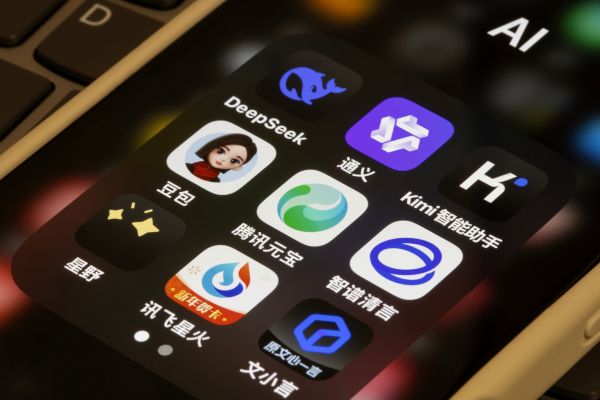
[DigitalToday Seung-a Yoo (유승아), intern reporter] China appears to be ahead of the United States in adopting artificial intelligence (AI) for consumers. As Chinese big tech companies such as Tencent and Alibaba directly integrate AI into applications used daily, AI is spreading more quickly than in the U.S. at consumer touchpoints, the analysis said.
On Sept. 15 local time, the Hong Kong-based South China Morning Post reported that a survey released by Morgan Stanley showed 80 percent of respondents in China said they use AI for personal purposes at least once a week. The figure for the United States was 54 percent. The survey found that while the U.S. leads in cutting-edge AI model performance, China leads in consumer AI adoption.
Morgan Stanley analysed China's strength as lying in service distribution tailored to local usage habits, rather than benchmark performance of cutting-edge AI models. In China, shopping, search, messaging and entertainment apps directly include text, image, video and code generation features, allowing users to access services without downloading a separate AI app.
China's generative AI user base has also expanded rapidly. It rose to about 602 million in December 2025 from about 249 million in December 2024. Morgan Stanley said the pace of growth was faster than the spread of mobile internet over a similar period.
Among standalone AI apps, ByteDance's Doubao took the lead. It logged about 399 million monthly active users in July, based on traffic flowing in from Douyin, China's version of TikTok. Alibaba's Qwen followed with 161 million. Qwen is an AI agent that performs real tasks by linking directly to Alibaba's shopping, travel booking, navigation and payment platforms.
Still, no trend emerged of a single AI app dominating the market. Morgan Stanley said 64 percent of respondents in China use five or more AI tools, and so-called multihoming has become common. With low switching costs between apps, it is difficult for a winner-takes-all structure to form among standalone AI apps, and existing platforms with user demand and their own data and transactions have an advantage, the analysis said.
As a result, existing platforms with strong distribution networks were assessed as likely to benefit from the spread of AI. Tencent in particular was analysed as having a WeChat ecosystem with a social graph, mini-programmes and payment functions that is likely to be strengthened rather than replaced by AI tools.
Alibaba was also cited as a top pick for Morgan Stanley because it has a full AI stack. In-app commerce functions such as Taobao's Qwen shopping assistant were highlighted. Morgan Stanley was cautious, however, about investment in the standalone Qwen app.
Meituan and online travel agencies were also mentioned as companies in favourable positions. They were assessed as having low incremental customer acquisition costs but high conversion efficiency into service use, a structure that could benefit from tying AI into their services.
 Seung-a Yoo
ysah@d-today.co.kr
Seung-a Yoo
ysah@d-today.co.kr