
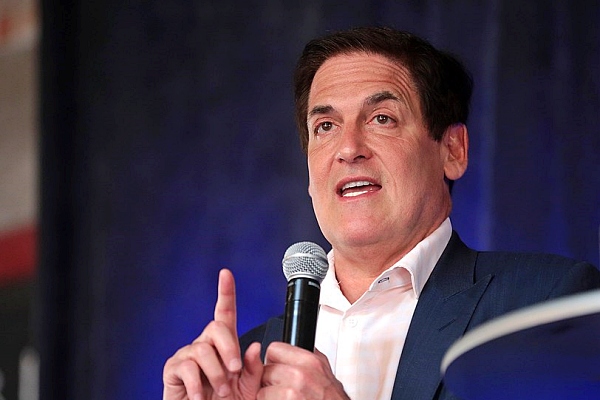
[DigitalToday reporter Yoonseo Lee] Billionaire Mark Cuban (마크 큐반) argued that human reactions around artificial intelligence (AI) could pose a bigger threat to humanity than AI itself.
Business Insider reported on Sept. 15 that Cuban said on X, formerly Twitter, that people encountering information on social media and taking action could be far more dangerous than an “agent swarm,” in which multiple AI agents operate as a group.
In another post, he also stressed that he is more concerned about how humans will respond to AI than the technology’s actual risks. He also said it is impossible to stop AI development.
His remarks came after some researchers again raised concerns that AI could eventually eliminate humanity. OpenAI CEO Sam Altman and Anthropic CEO Dario Amodei have also backed slowing the pace of development to control risks, while Cuban focused on how fear spreads rather than catastrophe from the technology itself.
He pointed in particular to social media algorithms, saying they are excessively stoking anti-AI sentiment. Companies such as Meta and Alphabet that own both social media platforms and AI models could end up in a contradiction, he said, backing their own AI while their platforms fuel hostility toward AI.
Cuban also cited OpenAI and Anthropic as another paradox. He said those companies have the most powerful AI models, but are not powerful enough to reverse-engineer social media algorithms and make content tailored to them go viral. Separate from competition over AI performance, he raised the issue that platforms’ distribution structures carry greater influence in shaping public opinion.
He has previously pointed to both AI’s limitations and risks in industry structure. He assessed that current AI models fall short of humans in understanding the meaning contained in results or grasping context.
The debate over calls to slow AI has continued among investors. Investor Michael Burry, known from the film “The Big Short,” said of AI chatbots with improved performance that “there’s nothing to be afraid of,” and criticised calls to slow development as “for their own benefit.”
Against that backdrop, Cuban’s remarks shift the focus of discussions about AI risks from the technology itself to information distribution structures and social reactions. Separate from support and opposition over development speed, the way platform algorithms amplify AI discourse is increasingly likely to emerge as a variable in future debate.
“I think it’s going to be interesting to watch the irony of the social media algos amplifying the anti AI sentiment far beyond any positive AI sentiment. Meta and Google are going to be trying to make enough money from pushing people to hate AI, to subsidize their AI”
 Yoonseo Lee
yslee@d-today.co.kr
Yoonseo Lee
yslee@d-today.co.kr