
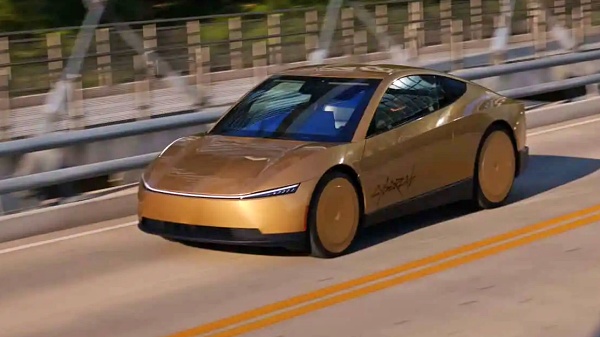
The U.S. National Highway Traffic Safety Administration (NHTSA) has formally demanded that Tesla prove the legality of selling and operating its autonomous-only vehicle, the Cybercab. Tesla must explain how the Cybercab, which has no steering wheel, pedals or side mirrors, meets current federal motor vehicle safety standards.
On Sept. 15, Electrek reported that NHTSA issued a special order to Tesla on Sept. 10 and demanded sworn statements on whether the Cybercab meets safety standards.
Tesla must submit its response by Sept. 30. If it fails to provide complete and truthful answers to NHTSA's demands, it could face penalties of up to $139 million. The response must be submitted under oath by a responsible Tesla executive, and if false statements or concealment of information are confirmed, penalties including fines or up to 15 years in prison could apply.
The move follows NHTSA's launch of audit inquiries shortly after Tesla began a commercial Cybercab service in Austin on Sept. 3. By issuing a legally enforceable special order rather than a routine information request, NHTSA is seeking to determine whether Cybercab sales and services comply with current rules.
NHTSA's special order consists of 21 items. It was reported to have been sent by NHTSA chief counsel Peter Simshauser to Tesla's head of litigation and its deputy general counsel for regulatory matters.
The central issue is Tesla's self-certification method for the Cybercab. In the United States, the government does not pre-approve vehicle designs; instead, automakers certify on their own that a vehicle meets all applicable federal motor vehicle safety standards, and the government verifies that certification after the fact.
Tesla certified that the Cybercab meets all applicable federal motor vehicle safety standards. But many current standards are built on the premise that a human directly drives the vehicle. Braking requirements are a key issue. Federal Motor Vehicle Safety Standard No. 135 requires service brakes to operate through a device actuated by the foot. The Cybercab, which has no driver's seat or pedals, does not have such a physical control device.
NHTSA has publicly stated that vehicles that do not use a foot-actuated brake cannot be certified under that standard. It is therefore demanding a detailed explanation of the basis on which Tesla concluded that a pedal-less Cybercab meets Standard No. 135.
NHTSA is also pursuing revisions to related rules for automated vehicles. In June, it proposed amendments to existing regulations to account for vehicles equipped with automated driving systems.
But the proposed amendments are not yet final rules. Current safety standards apply until final rules are established. Since Tesla began selling the Cybercab and launching paid services before the relevant rules change, NHTSA is assessing legality based on the current regulations.
Whether temporary control devices were used is also under review. NHTSA is asking whether Tesla ever temporarily attached control devices to the Cybercab so a person could drive it, and whether it used that as a basis for certifying compliance with safety standards.
If Tesla determined it met safety standards based on a vehicle fitted with control devices at the time of certification but removed them before delivery, another issue could arise. That is because it could conflict with rules on "rendering inoperative" that bar removing required safety equipment after certifying a vehicle and before selling it.
NHTSA said its review will cover not only braking but also Standard No. 101 on controls and telltales, Standard No. 102 on transmission shift position, Standard No. 108 on turn-signal self-cancellation, Standard No. 111 on mirrors and rear-visibility systems, and Standard No. 126 on electronic stability control telltales.
NHTSA is also raising questions about whether automakers can decide on their own that specific safety standards are "not applicable." It said separate regulatory judgment is needed on whether current safety standards can be arbitrarily excluded even for vehicles like the Cybercab that differ in design from existing cars.
Whether an exemption was granted is also a key issue. NHTSA has said in a 2022 rule that additional changes to safety standards may be needed to manufacture for sale vehicles operated solely by automated driving systems and that, until then, an exemption under Part 555 may be required.
Tesla has not received such an exemption so far. NHTSA is demanding an explanation of how Tesla could legally sell the Cybercab and deploy it for paid services without a separate exemption.
There is a comparison case. Amazon's autonomous driving unit Zoox in July received a temporary exemption from NHTSA under Part 555, allowing it to deploy a robotaxi with no steering wheel or pedals in paid services. Zoox's approval included exemptions for Federal Motor Vehicle Safety Standard No. 135 on braking and No. 111 on mirrors. It also set a limit of 2,500 vehicles per year and an effective period through 2028. Zoox first obtained an exemption for demonstration and then secured an additional exemption for commercial use.
By contrast, Tesla began a paid robotaxi service on Sept. 3 after self-certifying that the Cybercab meets current safety standards, without going through a separate exemption process.
As a result, this NHTSA probe is expanding beyond the question of the Cybercab's technical safety. It is becoming a broader issue of what procedures can be used under the current vehicle regulatory framework to commercialise robotaxis that lack basic controls such as a steering wheel and pedals.
The Cybercab's operating scope is currently limited. It was reported that until a formal regulatory judgment is made, the service will run at low speeds mainly along routes within a limited geofenced area and in a way that avoids railroad crossings.
 Jinju Hong
hongjj@d-today.co.kr
Jinju Hong
hongjj@d-today.co.kr