
The Korea IPTV Broadcasting Association is moving to expand use of the “TV Index” to verify actual viewing levels that existing TV ratings surveys have not captured, using set-top box data from the three IPTV operators.
The association held a media study on Sept. 15 at Chungjeong Tower in Seoul’s Seodaemun district under the theme “Changes in domestic media usage patterns and the direction for using TV Index”. It introduced the need for data-based measurement of broadcast viewing and the role of TV Index.
TV ratings surveys in South Korea currently estimate overall ratings based on viewing records from about 4,000 households. In contrast, TV Index integrates and analyses viewing data from about 18 million home set-top boxes of the three IPTV operators, including KT, SK Broadband and LG Uplus, to identify reach and viewing time by channel.
Lee Seo-yong (이서용), a team leader at IGAWorks who presented at the event, explained that as the number of TV channels increases and viewing routes diversify through over-the-top services and YouTube, it has become difficult for sample surveys alone to capture increasingly segmented viewing behaviour.
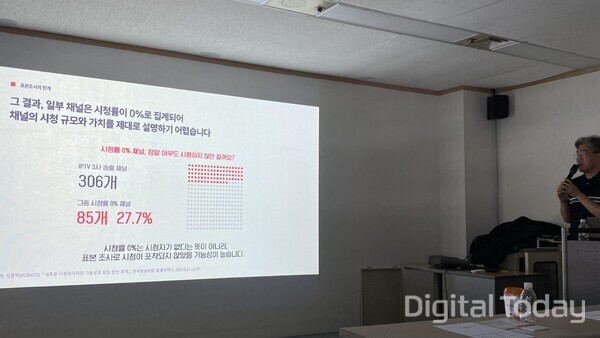
According to data from the Korea Broadcast Advertising Corp, among 306 channels carried by the three IPTV operators, 85 channels were recorded as having 0 percent ratings in existing ratings surveys, accounting for 27.7 percent of the total. Lee said a 0 percent rating does not mean there are no viewers, but that it is highly likely viewing was not captured in the sample survey.
TV Index can also confirm even small-viewing channels with specific figures. As of August 2026, CNTV’s rating was 0.0902 percent, but the number of TVs that were watched at least once during the month was 11,521,705, and total viewing time was tallied at 20,043,167 hours.
Channel A’s rating over the same period was 0.3590 percent, but monthly viewing was 19,560,160 TVs and total viewing time was 80,332,362 hours.
The association explained that rather than replacing ratings themselves, TV Index is meaningful because it presents absolute indicators such as reach and viewing time together, showing actual usage levels of broadcasting more intuitively.
For KBS2, the monthly rating in August was 1.0292 percent, but monthly viewing based on TV Index was 22,458,296 TVs and total viewing time was tallied at 234,990,047 hours. Average monthly viewing time per TV was 627.8 minutes.
Lee said the aim was not to ignore or abolish existing ratings. He said viewing ratings combined with other indicators such as actual reach and viewing time could express the value of broadcasters and channels more clearly.
A plan was also presented to broaden the scope of measuring TV advertising performance. TV advertising currently measures performance centred on ad viewing and exposure, but linking set-top boxes and mobile devices in the future could make it possible to analyse behavioural data such as app use, web visits and purchases after ad viewing.
The function is not currently provided by TV Index and is a direction for future expansion.
Korea IPTV Broadcasting Association Chairman Yoo Yong-hwa (유용화) said the importance of data that can measure and use the value of broadcasting from more diverse perspectives is growing as media usage patterns diversify. He said the association would, based on large-scale viewing data held by IPTV, show more concretely the value of broadcast content and channels and expand data use across the media industry, including broadcasters and programme providers.
 Seulgi Son
sageson@d-today.co.kr
Seulgi Son
sageson@d-today.co.kr