
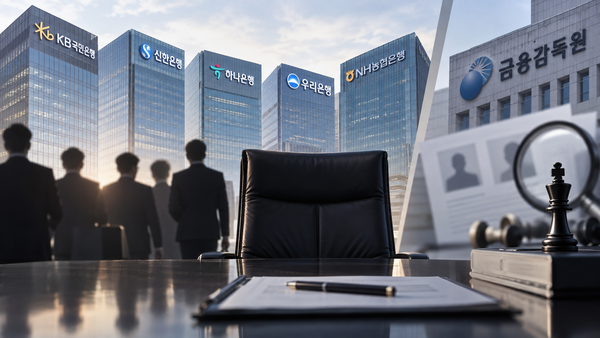
An expected formula of reappointing financial sector chief executives is being shaken. KB Financial Group chose Lee Jae-geun as its next chairman instead of reappointing Chairman Yang Jong-hee, despite record results. Attention is now focused on next week’s final candidate for the top job at Sh Suhyup Bank. The terms of the heads of the five largest banks also end at year-end. The Financial Supervisory Service has also signalled tougher checks of CEO succession procedures, heightening tension across the sector.
On Sept. 16, the financial sector said Suhyup Bank’s CEO Candidate Recommendation Committee will interview 6 candidates for the next CEO on Sept. 21 and decide a final candidate on Sept. 22. Three internal candidates are Shin Hak-gi (신학기), the incumbent CEO, and former vice presidents Jeong Cheol-gyun (정철균) and Park Yang-su (박양수). Three external candidates are Lee Hyung-ju (이형주), head of the Korea Financial Intelligence Unit (FIU), Kang Cheol-seung (강철승), head of the Korea Fisheries Policy Forum, and Lee Hyung-seung (이형승), an outside director at BNK Securities.
The sector is watching a contest between Shin, an internal candidate, and Lee Hyung-ju, a financial regulator. If Shin is reappointed, he would become the first reappointed CEO since Suhyup Bank was spun off from the National Federation of Fisheries Cooperatives in 2016. If Lee is selected, it would draw attention because a serving senior financial regulator would move to become a bank chief executive.
Scrutiny of the selection process is also continuing. The financial union recently questioned whether sufficient vetting is being carried out after the committee passed all 6 applicants through document screening. It argues that candidates should be vetted not only for financial expertise and management ability but also for understanding Suhyup’s cooperative identity and the fisheries industry. It also stressed that there should be no undue intervention by outside bodies such as political circles or the government.
Suhyup Bank will be the first major case to produce an outcome ahead of year-end selections for top bank jobs. In 2024, Suhyup Bank also decided on Sept. 24 to name Shin, then the senior executive vice president, as its next CEO candidate. Later that year, KB Kookmin Bank, Hana Bank, Woori Bank and NH NongHyup Bank all chose new CEOs among the five biggest banks, except Shinhan Bank, leading to a large-scale leadership reshuffle.
KB Financial earlier opted for change. On Sept. 11, KB Financial’s Chairman Candidate Recommendation Committee recommended Lee Jae-geun, a division head at KB Financial, as the final candidate for next chairman instead of Yang, who sought reappointment.
Given that KB Financial posted its best-ever level of results during Yang’s tenure, the financial sector had widely viewed his reappointment as likely. But as KB opted for new leadership over continuity, a sense has grown that strong results alone cannot guarantee a sitting chief’s reappointment.
Attention is also on CEO appointments at affiliates under a new chairman. Since KB Financial explicitly put change and generational shift at the forefront in selecting its chairman, a key question is whether the same line will continue in year-end affiliate appointments.
◆ More variables for year-end financial sector appointments
At year-end, the terms of Lee Hwan-ju (이환주), CEO of KB Kookmin Bank, Jeong Sang-hyeok (정상혁), CEO of Shinhan Bank, Lee Ho-seong (이호성), CEO of Hana Bank, Jeong Jin-wan (정진완), CEO of Woori Bank, and Kang Tae-young (강태영), CEO of NH NongHyup Bank, all end on Dec. 31. Four of them, excluding Jeong, took office in January 2025 and will complete their first two-year terms. Initially, many expected reappointments rather than a major reshuffle, considering each bank’s solid results and continuity.
But each bank has variables. Lee Hwan-ju lifted results in his first term, but a new holding company chairman means the bank CEO appointment will be the first major affiliate personnel decision under Lee Jae-geun’s leadership. Since KB Financial highlighted a generational shift in its chairman selection, attention is on whether a change-oriented approach will continue in the bank CEO appointment as well.
At Shinhan Bank, focus is on whether Jeong Sang-hyeok will win another reappointment. Jeong took office in 2023 and was reappointed once, and is now serving a second term. Stable results are cited as a strength, but executives Choi Hyuk-jae (최혁재) and Lee Bong-jae (이봉재) have also been mentioned as possible successors, along with whether he will be reappointed again.
At Hana Bank, both results and past personnel practice must be weighed. Lee Ho-seong has built a case for reappointment with strong performance since taking office, but Hana Bank has had no CEO reappointment case since Ham Young-joo, the incumbent chairman of Hana Financial Group. At Woori Bank, Jeong Jin-wan’s reappointment has been mentioned in consideration of Chairman Lim Jong-ryong’s reappointment at Woori Financial Group and management continuity. Kang Tae-young at NH NongHyup Bank will also complete a first term, but a variable is that reappointments have been rare at the bank except for former CEO Lee Dae-hoon.
Selections for financial holding company chairmen will also continue. Lee Chan-woo (이찬우), chairman of NH NongHyup Financial Group, will see his first term end on Feb. 2 next year, and discussions to pick the next chairman are expected to gather pace late this year. Since its launch in 2012, only 2 of the 7 chairmen have been reappointed at NongHyup Financial, showing that reappointments are not common.
iM Financial is also preparing to start succession procedures for its next chairman ahead of Chairman Hwang Byung-woo (황병우) reaching the end of his term in March next year. Hwang has been mentioned as a reappointment candidate after leading iM Bank’s conversion into a nationwide commercial bank and improving results. But after KB Financial replaced its incumbent chairman in an unexpected move, it has become harder to predict outcomes based on continuity alone.
Tighter oversight by financial authorities has also emerged as a variable. On Sept. 15, Lee Chan-jin (이찬진), head of the Financial Supervisory Service, pointed out at an executive meeting that succession procedures are set to proceed through year-end for many CEOs of financial holding company subsidiaries, including bank CEOs, and that most holding companies’ subsidiary CEO succession procedures were found to be insufficient. He cited cases where CEO qualification requirements were not specific, the management of standing candidate pools was handled formally, and procedures for narrowing and vetting candidates were opaque.
Lee stressed the need to strengthen transparency and fairness throughout the CEO succession process, including selecting and vetting the candidate pool, evaluation and record-keeping. He also said CEO appointments should not be run in a closed manner based on specific factions or personal ties.
As a result, leadership appointments in the financial sector this year are increasingly being shaped not only by whether incumbents are reappointed or replaced but by the candidate selection and vetting process itself. That is because KB Financial chose change despite strong results, and financial authorities have also signalled they will directly scrutinise CEO succession processes. Attention is focused on what choices each financial firm will make in appointments that start with Suhyup Bank on Sept. 22 and extend to the five largest banks and financial holding companies at year-end.
Lee Chan-jin, the FSS chief, said, "Financial companies should strive to operate transparent and fair management succession procedures in a way that can contribute to enhancing shareholder value." He added, "The Financial Supervisory Service will also strengthen checks on whether CEO succession is carried out according to transparent and fair standards."
 Ji-young Lee
ljy@d-today.co.kr
Ji-young Lee
ljy@d-today.co.kr