
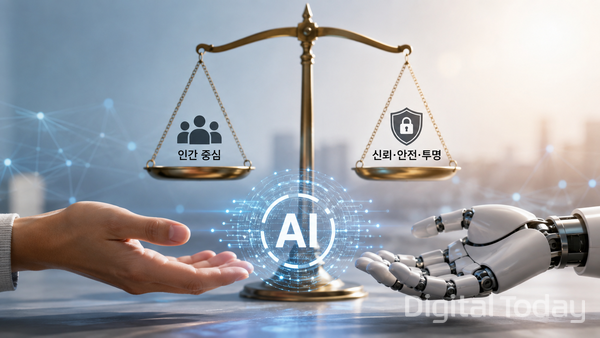
South Korea's Ministry of Science and ICT gathered views from industry, civil society and academia ahead of adopting the 'Korea AI ethics principles', a voluntary code that members of society should follow in the development and use of AI.
The ministry and the Korea Information Society Development Institute (KISDI) said on Thursday they held a public forum in Seoul under the theme, "AI for everyone, building AI ethics principles together." About 70 people attended, including industry representatives, civic groups, academics and members of the public.
The government has been preparing the 'Korea AI ethics principles' since late last year under Article 27 of the AI Basic Act. The core is to carry forward the 'AI ethics standards' prepared in 2020 while reflecting recent advances such as agentic AI and physical AI and changes in the policy environment after the AI Basic Act took effect.
After releasing a first draft in May, the ministry and KISDI drew up a revised version after receiving a total of 116 written opinions from industry, civic groups, academia, relevant ministries and members of the public.
The draft ethics principles present seven principles based on three key values: human dignity, the common good of society, and the sustainability of humanity. The seven principles are human-centredness, privacy protection, fairness and inclusiveness, accountability, safety, reliability and transparency.
Lee Sang-wook (이상욱), a professor in Hanyang University's departments of philosophy and AI, stressed that the ethics principles should not be a tool to constrain AI innovation. He said they should help developers and users consider various factors in development and use and play a role in making that possible in practice.
In the plenary discussion that followed, participants offered views on the nature of the ethics principles, public participation and ways to apply them in industry.
Byun Soon-yong (변순용), a professor in the department of ethics education at Seoul National University of Education, said, "As AI has become a basic social infrastructure, there is a need to move away from the perception of AI as something dangerous that requires caution."
Hong Yun-hee (홍윤희), chair of the board of directors at the incorporated association Muui, stressed that diverse citizens should be able to participate in the development and use of AI. She said citizens should be seen not as simple beneficiaries but as agents with rights.
From industry, a view was raised that the ethics principles should function as a reference standard in the field, but should not act as new regulation or a uniform obligation.
Kim Kyung-hoon (김경훈), Kakao's AI safety leader, said, "There is a need to ensure that ethical recommendations and legal obligations are not confused." Kim Hyun-joo (김현주), head of division at the Korea AI and Software Industry Association (KOSA), said ethics are important in playing a role to bridge the time lag between legislation and technological advances as new technologies emerge, including agent-type AI and physical AI.
Kim Kyung-man (김경만), director-general of the ministry's AI policy office, said, "The Korea AI ethics principles are standards that all of us must uphold together for a basic AI society." He added, "We will faithfully reflect the views raised at this forum to adopt the ethics principles and actively support all actors, including the government, companies and citizens, so they can put them into practice."
The ministry plans to refine the draft by reflecting views raised at the forum and then adopt and announce it within this month.
 Seulgi Son
sageson@d-today.co.kr
Seulgi Son
sageson@d-today.co.kr