
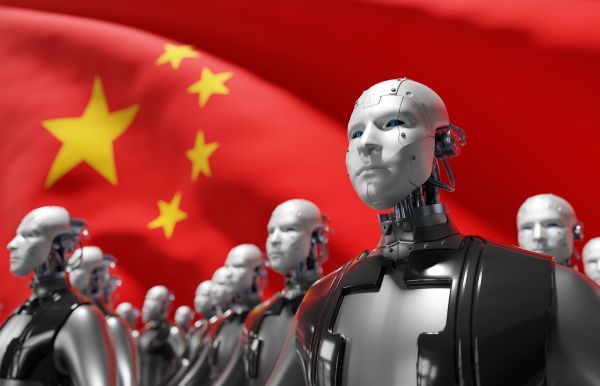
China's Hangzhou has opened a vocational school for humanoid robots and has moved to build a system of qualification exams before they are deployed at factories and service sites.
Cryptopolitan, a blockchain media outlet, reported on Aug. 11 that the school opened in Hangzhou, Zhejiang province, with an initial class of 30 humanoid robots.
The robots must receive practical training and pass certification tests before they are deployed in factories, services, security and entertainment. The curriculum has 4 tracks: technical functions, nursing and care, arts and sports. Operators first assess each robot's physical performance, then assign classes based on the results. They have the robots repeatedly perform real tasks by hand and then grant job certification through exams.
The core aim is to supply robots not as general-purpose experimental equipment but as job-ready labour prepared by role. Developers said the current sales model has customers take experimental machines and check for themselves whether they work. They said they will create a standard route in which companies buy robots that have already been trained, tested and certified for specific tasks.
Classes are not uniform. The curriculum is adjusted to each robot's hardware characteristics, including range of motion, gripping strength, sensors and walking stability. Developers explained that the goal is to secure smoother movement and reasoning capabilities. The robots operate on artificial intelligence that combines vision, language and action, allowing them to identify unfamiliar obstacles, interpret complex instructions and draw up new work plans.
The school was established jointly by Zhejiang University's robotics institute and several industrial partners. The facility operates as part of a national pilot base in China for embodied artificial intelligence. More than 140 robots are currently being trained at the base in more than 40 work environments, including smart kitchens, warehouses, farms and simulated mine tunnels without lighting.
The site is also highlighting cost savings from shared training infrastructure. Zhang Haiwei (장하이웨이), founder of motion-capture firm Qingmu, said it previously cost more than 10 million yuan, about $1.5 million, in training data alone to create a single application scenario. He said robot companies at the base are now sharing such resources.
Practical applications are also emerging. Logistics company Transfar and robot maker Unitree are operating a joint warehouse in which wheeled humanoids are assigned tasks such as picking, scanning and transporting goods. Smart forklifts load cargo with 1 millimetre precision.
The move is also tied to central government policy. China's Ministry of Industry and Information Technology and a state asset supervisory body issued a 2026 programme in June to promote real-world environment training and regular deployment. In Hangzhou, the first local regulation related to the humanoid industry also took effect on May 1. Hangzhou has more than 700 robot companies, and the city's embodied AI cluster recorded output of 106.8 billion yuan in 2025.
Even so, on-site deployment remains at an early stage. China shipped about 13,000 humanoids in 2025, but many are used for in-store guidance or responding at official events. Even humanoids in factories often remain at 30 to 40 percent of a human's speed in moving boxes. Against this backdrop, Hangzhou's robot school and pilot base are leading to an attempt to reduce performance variation and standardise humanoids into job units that can be deployed in practice.
 Jinju Hong
hongjj@d-today.co.kr
Jinju Hong
hongjj@d-today.co.kr