
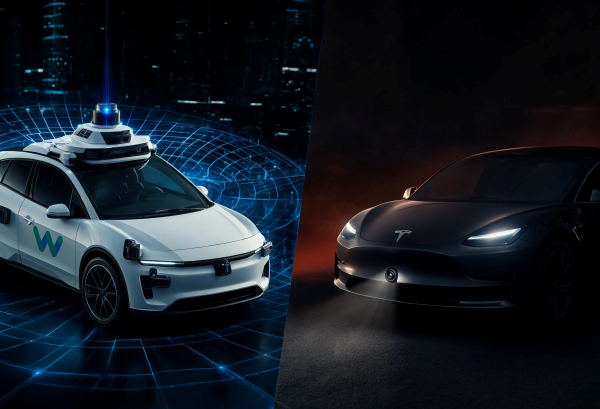
[Digital Today reporter Jinju Hong] Waymo and Tesla have once again gone head-to-head over self-driving technology. Waymo co-CEO Dmitri Dolgov (드미트리 돌고프) said it is difficult to achieve full autonomous driving with cameras alone, effectively questioning Tesla's camera-centric approach. Competition in the autonomous-driving industry is heating up again, from sensor configurations to safety validation.
Waymo CEO: Full autonomous driving not possible with cameras alone; points to Tesla limitations
Speculation has resurfaced that Uber and Waymo may part ways over their partnership, but Uber drew a line under it and stressed that cooperation between the two companies continues. At the same time, Waymo has fully opened its robotaxi service in Dallas, accelerating the expansion of autonomous-driving services in the United States.
Uber CEO: Not over with Waymo; dismisses split speculation Waymo fully opens Dallas robotaxi service
As China moves to speed commercialisation by establishing national safety standards for Level 3 and Level 4 autonomous vehicles, Nvidia has also released its self-driving AI for free to support wider adoption. With China refining regulatory standards and Nvidia expanding the technology ecosystem at the same time, the autonomous-driving race is spreading beyond development to a battle to secure standards and platforms.
China sets national safety standards for Level 3 and 4 autonomous driving; mandatory from 2027 Nvidia releases self-driving AI 'AlphaMayo 2 Super' for free; automakers can use it freely
The electric-vehicle ecosystem around Tesla is expanding beyond vehicles themselves to charging infrastructure and new mobility. Tesla officially acknowledged a defect in the power conversion system, or PCS, in pre-2026 model year Cybertrucks and extended the warranty for the part to 8 years or 150,000 miles. Vehicles covered by the extended warranty include 2024 and 2025 Foundation Series models and standard-spec vehicles.
A customised mini electric jet boat using a Tesla powertrain was completed after 3 years. Operators of the YouTube channel Prop Department set out to build it themselves after concluding that there are effectively no finished small electric jet boats that combine high output with high-speed driving.
U.S. charging operator EVgo has entered the charging-network race by directly installing Tesla's V4 Superchargers. The chargers being introduced support up to 500 kW of power and up to 1,000 volts. They support both J3400 (NACS) and CCS1 standards, allowing both Tesla and non-Tesla EVs to use the same equipment.
Tesla acknowledges Cybertruck power conversion device defect; expands warranty on existing models to 8 years An electric boat Tesla did not make, built by a YouTuber Tesla Superchargers now installed by others; EVgo to deploy V4 directly across the United States
Tesla's latest Full Self-Driving software was found to significantly boost response speed to sudden situations even on the same in-vehicle computer. The latest hardware, HW4, showed the fastest performance, but results also showed response times improved by more than 30 percent on older HW3 with a software update alone.
Tesla FSD not only faster on HW4; older HW3 improves 36 percent
U.S. President Donald Trump likened electric-vehicle drivers' range anxiety to a "disease" and again criticised EV policy. At a rally in Las Vegas, he claimed he "ended the EV mandate" and made derisive remarks that EV drivers worry about driving range.
Trump: EV range anxiety is a disease; again raises dispute over 'ending the mandate'
As the competitiveness of Chinese electric vehicles draws attention beyond price to product quality and technology, the possibility of an indirect entry aimed at the U.S. market is also being raised. A U.S. reporter who drove Chinese cars assessed their competitiveness by comparing them with local brands, while forecasts also emerged that Chinese companies could pursue a strategy to enter the market with U.S. automakers while "erasing the Chinese-car look".
U.S. reporter who drove 25 Chinese cars picks strengths of Chinese EVs So you don't know it's Chinese? Chinese EVs may enter indirectly by teaming with U.S. automakers
U.S. EV startup Aptera has begun preparations for initial mass production of a three-wheeled electric vehicle equipped with solar panels. After securing U.S. Environmental Protection Agency certification for the production model, it completed orders for parts needed to build vehicles for first customer deliveries, bringing commercialisation within reach.
U.S. solar three-wheeled EV: Countdown to mass production of 40 units; 'no-charging EV' nears commercialisation
Electric bicycles are moving beyond simple short-distance transport and into performance competition closer to electric motorcycles. Models have emerged ranging from high-performance versions with a top speed of 98 km per hour to dual-battery products that can travel up to 200 km on a single charge, pushing the limits of both range and output.
Pedals, but electric-motorcycle grade: High-speed 98 kph electric bicycle emerges Juiced launches dual-battery e-bike; runs up to 200 km on a single charge
 Jinju Hong
hongjj@d-today.co.kr
Jinju Hong
hongjj@d-today.co.kr