
Google will expand payment choice for Google Play developers in South Korea and cut service fees to as low as 10 percent. It will broadly allow payments not only through the Google Play billing system but also through developers' own payment systems and external websites. The aim is to reduce developers' cost burdens and expand their options for running their businesses.
Google Korea on Monday published a question-and-answer interview with Kara Bailey (카라 베일리), vice president of Android ecosystem strategy, and outlined the direction of the Google Play business model overhaul.
The core of the overhaul is expanding developers' choice of payment methods. Developers can offer an alternative payment system alongside Google Play billing, or send users to their own websites to complete purchases. They can also design their own payment choice screen in line with Google's user experience guidelines instead of using the payment selection screen provided by Google Play.
Payments made through external links must meet Google's safety standards, including maintaining child protection features and complying with PCI-DSS, an international payment information security standard.
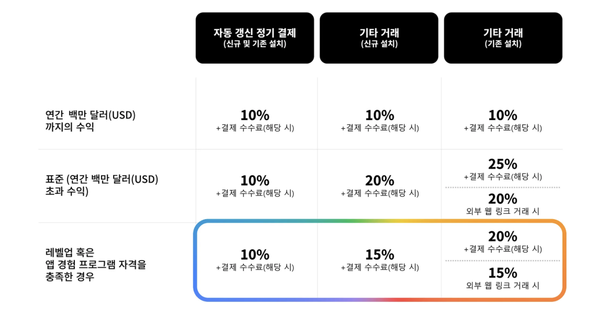
By fee tier, a 10 percent service fee will apply to the first $1 million, or about 1.4 billion won, of a developer's annual revenue generated through Google Play, regardless of payment method. Auto-renewing subscriptions will also be charged a 10 percent service fee regardless of revenue size.
For general transactions beyond $1 million in annual revenue, differentiated fees will apply depending on users and payment methods. After the overhaul, transactions by users who first install or update an app will be charged 20 percent, while transactions by existing installed users who used the app before the policy takes effect will be charged 25 percent. If external web payment is used, 20 percent will apply to both new and existing installed users.
If the Google Play billing system is used, an additional 5 percent payment processing fee will be charged in South Korea. By contrast, no separate payment processing fee will be charged for transactions using developers' own payment systems or external web links. As a result, developers using their own payments or external web payments are seen as having a lower payment cost burden than those using the Google Play billing system.
Google will also expand programs that support developers in acquiring users and growing their businesses, alongside the fee overhaul. It will revamp the existing Game Level Up program and introduce a new App Experience program.
The Game Level Up program provides game developers that deliver a certain level of user experience with greater visibility on Google Play, user engagement features and lower service fees. The App Experience program will also apply separate fee rates to apps that deliver high-quality user experiences on Android. For apps and games that meet eligibility requirements, the service fee on general transactions above the first $1 million will be lowered to 15 percent for new installed users and 20 percent for existing installed users, while 15 percent will apply to external web payments.
The overhaul was introduced first in the United States, the European Economic Area and Britain in June, and is set to take effect in South Korea on Dec. 31. Google said differences in implementation timing by country reflect the need to build additional technical infrastructure and coordinate with regulators in each country to change its business model.
In Japan, the company initially planned to implement the overhaul on Dec. 31 along with South Korea, but brought the start date forward to September after consultations with the Japan Fair Trade Commission, or JFTC, and local developers. Google said it could also bring forward the implementation date in South Korea depending on consultations with authorities.
The move comes as domestic regulatory discussions continue over the Telecommunications Business Act, known as the in-app payment anti-forcing law, which bars app market operators from forcing developers to use a specific payment method. On April 1, Kim Jong-chul (김종철), chair of the Korea Communications Media and Telecommunications Commission, met Wilson White (윌슨 화이트), Google's vice president for global public policy, and Bailey at the Government Complex Gwacheon. At the meeting, Google executives explained to the government the purpose and key details of the plan to lower Google Play billing fees.
Bailey said Google's current programs comply with South Korean regulations and stressed that the overhaul would further improve developers' choice and cost burden.
Bailey said, "Korea is one of the markets where the world's most innovative and dynamic developers are active, especially in games and webtoons," and added Google would support developers in growing their businesses and reaching global users.
 Hojeong Lee
lhj@d-today.co.kr
Hojeong Lee
lhj@d-today.co.kr