
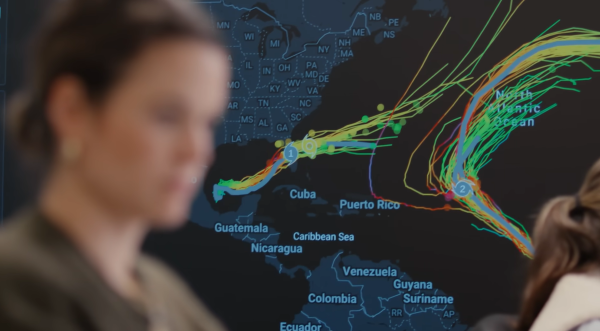
[Digital Today Seung-a Yoo] WeatherNext, an AI weather model developed by Google DeepMind and Google Research, was found to predict hurricane tracks and intensity more accurately than existing forecasting models.
IT outlet Ars Technica reported on Aug. 8 (local time) that researchers said the model, on average, secures one additional day of forecasting lead time. They said its three-day forecast accuracy is comparable to other models' two-day forecasts.
The findings were disclosed in a paper published in the journal Nature. Researchers said WeatherNext showed an unprecedented level of accuracy in cyclone forecasting. In the field, that one-day difference directly affects disaster response schedules such as evacuation decisions, supply deployment and the movement of response personnel.
Mike Brennan (마이크 브레넌), director of the U.S. National Hurricane Center, said, "Even a difference of a few hours can change things." He said the ability to pull forecast accuracy forward by one day is highly valuable. Hurricane response can lead to greater damage if timing is missed, while wrong decisions also carry heavy costs.
WeatherNext drew attention in the case of Hurricane Melissa, which formed in the Caribbean in October 2025. At the time, conventional weather models diverged on whether the storm would remain weak and head toward Haiti or strengthen and move to Jamaica. Five days before landfall, WeatherNext put the probability at 80 percent that the storm could hit Jamaica as a Category 5 hurricane. Melissa caused flooding and landslides across Jamaica, and the earlier warning gave communities more time to prepare.
Hurricane forecasting is considered difficult even for AI. Extreme weather events occur rarely, leaving insufficient training data. Ferran Alet (페란 알레트), a Google DeepMind researcher, said, "There is not much cyclone data, but there is a lot of weather data." He said the model was trained to handle overall weather and cyclones together.
Hurricanes are especially hard to forecast because both track and intensity must be predicted. Predicting the track requires global-scale information such as the position of cold fronts and prevailing winds. Predicting intensity, by contrast, requires much more detailed examination of local atmospheric and ocean conditions. Kate Musgrave (케이트 머스그레이브) of the Cooperative Institute for Research in the Atmosphere said it was difficult to obtain sufficient intensity information from existing global models, and that previous AI models, while good on tracks, "did not predict intensity well at all."
WeatherNext also showed strong performance in retrospective tests using past data, but researchers were initially unsure if the same results would appear in real operations. Musgrave said the results were so good she doubted they would be reproduced in real-time forecasting, but performance held after deployment to forecasters, and "everyone was surprised at how well it worked," she said.
Researchers are particularly focused on the fact that WeatherNext accurately predicts hurricane intensity even while using lower-resolution atmospheric data than traditional models. Alet said the research community was shocked to hear the resolution of the input data, suggesting that low-resolution information may contain signals that had been underestimated. Researchers have not yet fully explained which signals the model is capturing. He said AI is ultimately a "black box," but it can give physicists a signal that there are phenomena they did not previously understand.
WeatherNext does not produce only a single forecast and instead presents multiple scenarios. That is to reflect cases where small changes lead to large differences over time. Forecasters can review the results alongside other models and use them for final judgments. If the model produced 50 scenarios per storm last year, it now generates up to 1,000. Musgrave said it is difficult for conventional numerical forecasting models to generate scenarios at that scale with current computing resources.
Field experts drew a line, saying AI is not a tool that fully replaces forecasters. Brennan called WeatherNext a new addition to a forecaster's toolbox, but said one model performing well in a particular year or storm does not guarantee top performance in the next season or the next storm. He also stressed that hurricanes are not only about track or intensity figures and that the process of experts interpreting how real damage will unfold remains important.
Google DeepMind also said it will open-source the WeatherNext model used during hurricane season. That will allow researchers to use and improve the model directly, and is expected to help them find additional clues about how cyclones work.
 Seung-a Yoo
ysah@d-today.co.kr
Seung-a Yoo
ysah@d-today.co.kr