
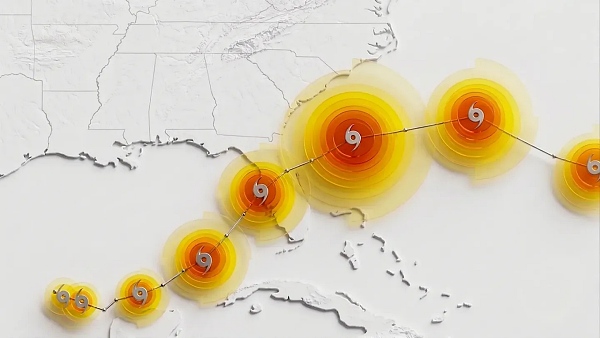
Google DeepMind has released the code and model weights for the weather AI models WeatherNext 2 and WeatherNext Cyclones.
Taiwan outlet iThome reported on Aug. 7 that WeatherNext Cyclones provided forecasts more than 24 hours earlier on average than major existing weather forecasting models at the same accuracy level when predicting tropical cyclone tracks, intensity and wind field ranges.
A study published in Nature said WeatherNext forecasts issued three days ahead showed accuracy similar to older models' two-day forecasts.
Forecasting tropical cyclones is difficult because their tracks and intensity are influenced by weather phenomena of different scales. Tracks are heavily affected by large-scale atmospheric circulation, which global weather models handle relatively well, but intensity depends on fine thermodynamic changes and convective activity around the core, so higher-resolution regional models have mainly been used.
WeatherNext Cyclones is designed to address both problems in a single AI model. It predicts changes in tropical cyclone tracks, intensity and wind fields, and provides forecasts up to 15 days. The research team trained the model on global atmospheric data and about 5,000 historical tropical cyclone cases so it could learn overall weather changes and the characteristics of tropical cyclone development.
The model delivered results in intensity forecasting even with input data at a grid resolution of about 28 km. Existing approaches had viewed higher-resolution data as necessary to capture detailed changes near the core. Google has not yet fully explained why the model can extract sufficient information from relatively coarse data, and left it as a follow-up research task.
Rather than producing a single outcome, WeatherNext generates multiple weather-evolution scenarios at once and then estimates the probability of each. Google produced 50 forecasts during the 2025 hurricane season and has now increased that to 1,000. This allows it to examine scenarios that are unlikely but have large impacts, such as cases where tropical cyclones rapidly intensify over a short period of time.
WeatherNext was provided as reference material for forecasts by the U.S. National Hurricane Center during the 2025 hurricane season. Google said the release would allow weather agencies and researchers to test the model directly or create derivative models. General users can check temperature, precipitation, wind speed and tropical cyclone forecasts generated by WeatherNext in Google Weather Lab.
 Hyunwoo Choo
cookinpapa@d-today.co.kr
Hyunwoo Choo
cookinpapa@d-today.co.kr