
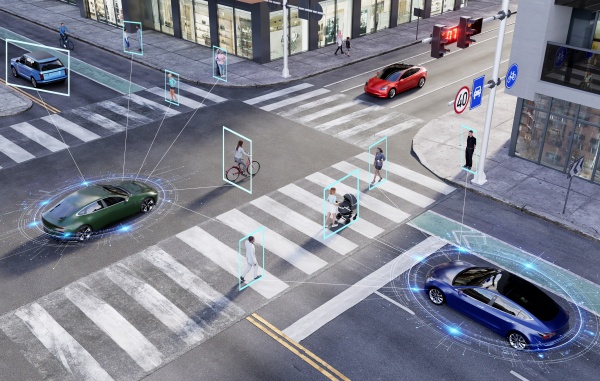
[DigitalToday reporter Jinju Hong (홍진주)] The Chinese government has prepared mandatory national safety standards for advanced autonomous driving systems at Level 3 and Level 4. As competition in autonomous driving technology intensifies, China is also moving quickly to build a safety management system for commercialisation as well as technology development.
On Aug. 6 (local time), electric vehicle media outlet CleanTechnica reported that China’s Ministry of Industry and Information Technology recently announced new safety standards applied to Level 3 and Level 4 autonomous driving systems. The standards are set to take effect on July 1, 2027.
The standards apply to autonomous driving systems installed in M-class passenger vehicles and buses and N-class commercial vehicles. Automated parking functions are excluded from the regulations.
The key point of the standards is that they expand the scope of automakers’ safety responsibility rather than focusing on the autonomous driving technology itself. The Chinese government required vehicle manufacturers to establish safety assurance systems across the entire product lifecycle, from the development stage through after-sales.
Manufacturers must conduct simulation tests, closed-course tests and real-road tests during the development of autonomous driving systems. The rules make mandatory procedures to verify that the system operates reliably in a range of situations, beyond simply securing driving performance.
The standards also strengthen the division of roles between humans and autonomous driving systems. They specify requirements for interaction between drivers and systems and for user guidance, while also requiring vehicles to be capable of performing dynamic driving tasks.
In particular, where the system handles driving under certain conditions, as in Level 3 autonomous driving, the driver must be able to immediately take back control when necessary. To do so, the vehicle must be able to check whether the driver is in a condition to intervene and request a handover of control at an appropriate time.
The Chinese government also plans to tighten controls on market entry for autonomous vehicles through the standards. The ministry said it will improve market access procedures for intelligent connected vehicles and continue to refine test methods and evaluation systems for autonomous driving systems.
China has pushed rapid commercialisation in electric vehicles and autonomous driving. Major electric vehicle companies are competitively expanding urban driving assistance and highway autonomous driving functions, and some companies are preparing Level 3 services under limited conditions.
As the pace of technology diffusion has accelerated, safety issues have also emerged as a key task. The less driver intervention autonomous driving systems require, the more important responsibility in the event of accidents and standards for system verification become.
With about a year of preparation before enforcement, the standards are not expected to deliver an immediate shock to the industry. Automakers and autonomous driving technology companies, however, will need broad responses going forward, including user education, driver monitoring and safety data management systems, as well as the development process.
The exclusion of automated parking is interpreted as meaning the Chinese government is focusing first on managing risks that can arise in real road-driving environments. Level 3 and Level 4 autonomous driving handles driving under limited conditions, but human intervention is still required in unexpected situations.
Competition in China’s autonomous driving market is likely to be determined not only by technological performance but also by safety verification capabilities. As the Chinese government is expected to continue adjusting test methods and market entry requirements starting with these national standards, changes are also expected to continue in autonomous driving companies’ response strategies.
 Jinju Hong
hongjj@d-today.co.kr
Jinju Hong
hongjj@d-today.co.kr