
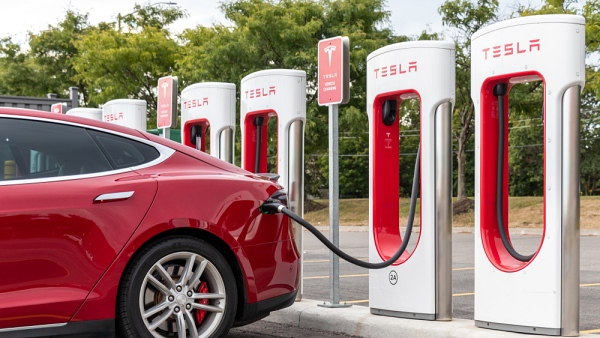
A shooting near a Tesla Supercharger in Twin Falls, Idaho has widened a safety debate over how electric vehicles can be hard to escape in an emergency while charging.
On Aug. 3, overseas media including EV outlet Electrek reported that on Aug. 1 a man opened fire at a newly opened In-N-Out Burger store and a nearby visitor centre parking lot. Video from the scene showed signs that gunfire was directed at a Tesla vehicle that was charging. Three people were killed and several were injured. The injured included a taxi driver who had been charging at the Supercharger. He survived but has reportedly undergone multiple surgeries since then.
Soon after the incident, EV drivers rapidly shared a third-party device called EVject as an alternative that lets a vehicle move immediately even when a charging cable is connected. The device, also called an Escape Connector, is designed to be fitted between a Supercharger cable and the charging port and mechanically separate when the vehicle drives off. It sells for $299. After the shooting, hundreds of Tesla owners on X, formerly Twitter, shared the product along with referral codes and promoted it as a solution to the shooting.
The issue is that the product is the same part that Tesla sued over on safety grounds just 2 years ago. Tesla filed a lawsuit against EVject in a California court in 2024, claiming the surface temperature could reach up to 100 degrees after 30 minutes of high-current charging and that it lacked an overheat protection design. EVject later released an improved version with built-in thermal protection, and Tesla dropped the lawsuit. Critics say it is problematic for the product to be recommended without any caveats, given it was in a legal dispute with Tesla until recently.
The core of the controversy is that the connector is physically locked while an EV is charging. To drive off, a driver typically has to tap to unlock the charging port on the vehicle screen or go through a manual release procedure, then wait until the cable is disconnected. In situations where seconds matter, the delay itself becomes a practical vulnerability.
Some also say EVject has limits as a fundamental solution. It helps only when a driver quickly recognises danger and can immediately put the car in gear and drive off. In a sudden and chaotic attack, making that judgement and taking those actions is not easy. It may be meaningful as a tool that cuts escape time by a few seconds, but selling a $299 adapter as a solution to random violence is seen as an exaggeration.
The issue is also not limited to Tesla. Charging standards such as NACS, CCS and J1772 all assume a locking structure to prevent arcing or accidental disconnection while high-voltage power is being supplied. Every EV fast-charging faces the same constraint, and the issue may look more pronounced simply because Tesla's Supercharger network has the most users, the report said.
Against that backdrop, the industry is increasingly urged to look at emergency release functions built into vehicles and chargers, rather than aftermarket accessories. A practical answer is a built-in emergency disconnect function operated from the driver’s seat. Because Tesla controls both vehicles and chargers, it can implement a method that ties power cut-off, unlocking and vehicle departure into a single intentional action. Critics also say such features should not remain limited to a single brand, and EV makers and charging operators broadly need to standardise emergency release procedures within safety standards.
The likelihood of experiencing a mass shooting is very low, so there is no need to avoid buying an EV based on this incident alone. Still, when gunfire occurs, staying inside a vehicle can be more dangerous. While charging, it is hard to move the car immediately and difficult to evacuate quickly, which can make it a target. By contrast, getting out and moving into a crowded store can make it easier to ask for help and can be advantageous for evacuating or taking cover.
 Seung-a Yoo
ysah@d-today.co.kr
Seung-a Yoo
ysah@d-today.co.kr