
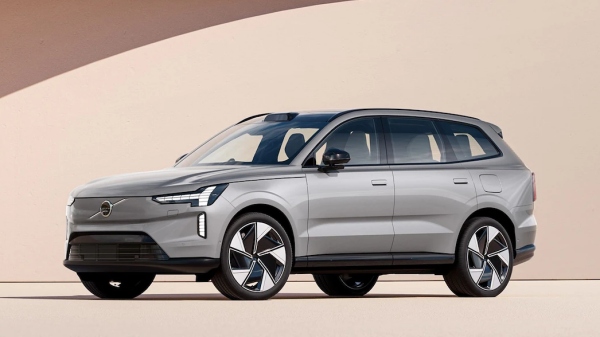
Volvo has stopped developing lidar-based functions for the EX90 electric SUV and ES90 electric sedan and has begun compensation procedures for existing buyers. The cars have lidar hardware, but the software functions using it will not be released.
On July 29, local time, electric-vehicle outlet Electrek reported that Volvo decided to stop developing functions using Luminar's Iris lidar mounted on the roof. Volvo is implementing country-by-country compensation plans for EX90 and ES90 buyers who will not receive the functions.
Henrik Uell Taig (헨리크 율 타이게), Volvo Cars' spokesperson in Norway, said Volvo has ended its partnership with lidar supplier Luminar and also halted plans to develop lidar-based functions that were to be applied to the EX90 and ES90.
Compensation differs by country. In Norway, Volvo will pay 18,000 Norwegian kroner per vehicle. In Sweden, it cut the sales price of the affected vehicles by 16,000 Swedish kronor in November last year. In the United States, it is offering optional benefits worth about $1,500, including a SiriusXM subscription, charging credits, tire and wheel coverage and a vehicle maintenance package. Buyers in the Netherlands will be compensated 1,500 euros, and buyers in Canada will receive 2,000 Canadian dollars.
The decision stems from lidar supply-chain problems. Volvo ended its contract with Luminar in November last year. The company cited supply-chain risks and failure to meet contractual obligations as reasons for ending the deal. Luminar later sought bankruptcy protection under Chapter 11 of the U.S. Federal Bankruptcy Code in December 2025, making sensor supply and after-sales support effectively difficult. Volvo explained that this made it difficult to release the lidar-based driver assistance functions it originally promised.
Volvo said the removal of lidar functions would not have a major impact on vehicle safety and the performance of its advanced driver assistance system, or ADAS.
The EX90 is equipped with 5 radars, 8 external cameras, 2 internal cameras and 16 ultrasonic sensors in addition to lidar, and the ES90 has a similar sensor setup. Volvo said this sensor combination and a high-performance computing system can provide a high level of safety and driver assistance functions.
Some in the market interpret the decision as a sign that automakers' lidar strategies are retreating. Volvo stressed that the direct causes were the end of its supplier contract and supply-chain instability, rather than abandoning a specific technology.
The case shows that even if hardware is installed, promised functions are not necessarily provided in the era of software-defined vehicles. It also raises the possibility that the manufacturer's move to compensate for missing functions with cash or service benefits could become a benchmark for similar disputes.
 Jinju Hong
hongjj@d-today.co.kr
Jinju Hong
hongjj@d-today.co.kr