
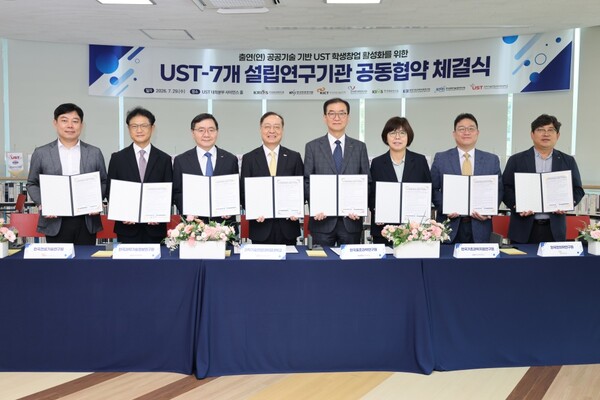
[Digital Today reporter Jin-ho Lee] University of Science and Technology (UST) is teaming up with seven national research institutes to promote student startups based on public technology.
UST said on Tuesday it signed a joint agreement at its headquarters with the Korea Research Institute of Standards and Science (KRISS), the Korea Astronomy and Space Science Institute (KASI), the Korea Institute of Civil Engineering and Building Technology (KICT), the Korea Institute of Oriental Medicine (KIOM), the Korea Institute of Materials Science (KIMS), the Korea Basic Science Institute (KBSI) and the Korea Institute of Science and Technology Information (KISTI) to promote UST student startups based on public technology at government-funded research institutes.
The agreement extends a pact signed in December last year with five national research institute schools including the Korea Research Institute of Bioscience and Biotechnology (KRIBB), the Korea Research Institute of Chemical Technology (KRICT), the Electronics and Telecommunications Research Institute (ETRI), the Korea Institute of Industrial Technology (KITECH) and the Korea Institute of Machinery and Materials (KIMM).
That brings the number of national research institute schools participating in the UST student startup promotion agreement to 12. UST plans to expand the agreement to cover all schools.
The signatories will build a "professor-student companion" startup model that includes public startups, technology transfer and technology equity contributions. They will support the identification of student founders, entrepreneurship training and mentoring. They will provide research outcomes and proprietary technologies from government-funded institutes by linking them with technology licensing offices. They will also support joint use of research space, equipment and facilities, and pursue project and funding support for startup activities and pre-startup projects.
Under the model, professors and students jointly carry out processes such as startups, technology transfer and technology equity contributions based on advanced public technologies and research infrastructure held by national research institutes. Since the appointment of President Dae-im Kang (강대임), UST has been promoting deep-tech student startups with the goal of becoming a national research institute university where student startups emerge.
Last year, UST said it revised guidelines for regulations on startups by researchers at government-funded institutes through consultations with the National Science and Technology Council (NST), and overhauled systems to allow UST students to start businesses while enrolled. It also strengthened its startup support system by appointing Ji-ho Choi (최지호), CEO of Korea Science and Technology Holdings (KST), and Cheol-hwan Kim (김철환), chairman of the Kaite Entrepreneur Foundation, as special startup faculty members, and signing a business agreement with KST.
In June, UST held its first student startup competition, the 2026 UST Startup Track. A total of 15 student-professor teams from 12 national research institute schools took part, and 5 teams were selected as final winners.
Kang said UST would support turning cutting-edge technologies developed by professors and students at national research institute schools into startups. He said it would work comprehensively with the schools so that talent trained at national research institutes can establish itself as one pillar of domestic deep-tech entrepreneurship.
 Jin-ho Lee
jhlee26@d-today.co.kr
Jin-ho Lee
jhlee26@d-today.co.kr