
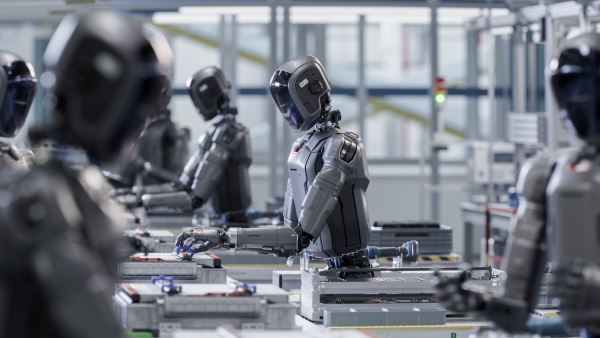
The U.S. government has decided to curb new imports of foreign-made advanced robots with network connectivity and power inverters, citing national security. The move expands China-focused curbs that had centered on telecommunications equipment to robots and energy equipment, and Chinese companies are expected to be hit hardest.
On July 28 (local time), the Verge reported that the U.S. Federal Communications Commission (FCC) announced it will add advanced robots with network connectivity and foreign-made power inverters to the list of items subject to restrictions on new imports, citing national security and user safety.
The move covers not only humanoids and quadruped robots but a wider range of mobile devices. In an FAQ, the FCC defined advanced robots as devices that move autonomously on the ground or avoid obstacles and are equipped with sensors that recognize their surroundings and chips for network connectivity. Products weighing more than 4.4 pounds (about 2 kg) are subject to the restrictions.
That raises the possibility that some robot vacuums released in the future could also struggle to enter the U.S. market unless they obtain waiver approval. The FCC said there is an "unacceptable risk" to U.S. national security and to public safety and security.
While it said the measure does not explicitly target any particular country, the industry expects Chinese companies to be affected most. China has been rapidly expanding production of humanoid robots and has major global players such as Sungrow and Huawei in power inverters used in solar and renewable energy facilities. Huawei is already subject to U.S. government sanctions.
The restrictions do not apply retroactively to products already in use. Individuals and companies in the United States can continue using robots and power inverters they already have. Companies seeking to supply new products to the U.S. market must obtain waiver approval. The FCC required applicants to submit detailed plans to shift production to the United States rather than a simple security enhancement plan. Applicants must present a specific roadmap for starting production in the United States.
The FCC also said it plans, through waivers, to ensure all robots and power inverters can receive security and compatibility updates by Jan. 1, 2029. For now, there is no obligation for companies to separately report to the FCC when they distribute security updates.
The industry views the move as an expansion of supply-chain rules that the United States has applied to telecommunications equipment, extending them to robots and energy equipment. The fact that waiver standards place greater weight on production bases and supply-chain restructuring than on a product's own security is also drawing attention.
The market expects the U.S. robot and power equipment market to face simultaneous pressure from security regulation and shifts in production bases, with speculation that many companies with production bases outside China could be excluded from the restrictions.
 Jinju Hong
hongjj@d-today.co.kr
Jinju Hong
hongjj@d-today.co.kr