
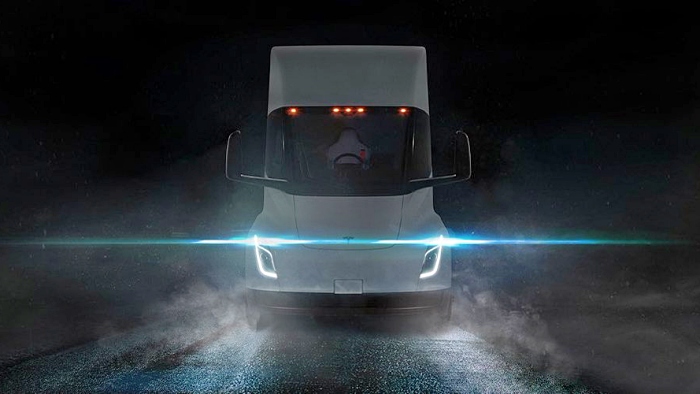
[DigitalToday Seungah Yoo, intern reporter] Elon Musk said the self-driving function of Tesla's electric truck, the Semi, could be operational late this year or early next year.
On July 27 local time, electric vehicle outlet Electrek reported that when Lightshed analyst Walter Piecyk asked about the timing of Semi self-driving, Musk gave that answer on Tesla's 2026 second-quarter earnings conference call held on July 22.
Musk first mentioned a labour shortage at U.S. logistics sites. "There are not enough people who want to drive trucks that are essential for transportation across the United States," he said. On Semi self-driving, he said adding autonomous driving to the Tesla Semi used by truck drivers would greatly improve safety and convenience.
Tesla said Semi self-driving is not an immediate top priority. Musk said the current focus of self-driving development is on mass-produced vehicles such as the Model 3, Model Y and Cybercab, adding that Semi self-driving is "somewhat lower priority for about the next six months." That means development resources are being prioritised for passenger vehicles and robotaxis even as he offered a timeline.
The Semi has been associated with self-driving from the start. When Tesla unveiled the Semi in November 2017, it highlighted "Enhanced Autopilot" and a platooning demonstration in which multiple trucks autonomously followed each other on highways. Mass production was presented at the time as starting in 2019, but it was later repeatedly delayed to 2020, 2021 and 2022.
When some vehicles were delivered to PepsiCo in late 2022, Tesla did not separately mention Autopilot or self-driving. References to platooning that had once been introduced on its website were also removed. Then, in April this year, the first Semi rolled off a mass production line at the Nevada Gigafactory. The plant was designed to have an annual production capacity of 50,000 vehicles. But Tesla told investors this week that even as of the end of 2026, the Semi would remain a "very small share" of its total vehicle fleet.
The market's cautious view of self-driving timelines stems from Tesla having repeatedly suggested similar timing in the past. Musk said on the call that Semi self-driving could be possible "late this year or around early next year," but Tesla has missed most of its past schedules related to full self-driving and robotaxis. In 2016, it said a Tesla vehicle would drive itself from Los Angeles to New York. In late 2019, it said full self-driving would be essentially complete, but it did not happen. In 2020, Musk said he was "100 percent confident" Tesla would solve Level 5 autonomy the following year.
A key current self-driving target Tesla maintains is to deliver unsupervised full self-driving in customer vehicles in the fourth quarter of 2026. Tesla is also continuing related tests in its Texas robotaxi service, but the Semi, due to its size and operating environment, requires a higher level of reliability and expanded operating range than passenger vehicles.
As a result, the Semi self-driving programme is likely to hinge more on its actual priority and mass production schedule than on the announcement itself. Tesla has begun establishing a mass production base for the Semi, but the timing of applying self-driving functions will likely need to be watched alongside progress in passenger-car-focused development for the time being.
 Seungah Yoo
ysah@d-today.co.kr
Seungah Yoo
ysah@d-today.co.kr