
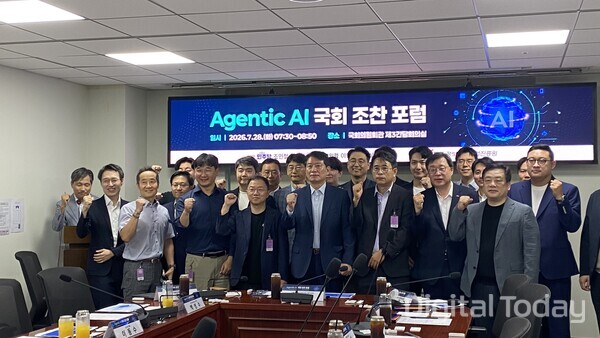
In the agentic AI era, calls are growing to improve AI model performance and build infrastructure centered on memory and neural processing units (NPUs), as economic efficiency will hinge on finishing tasks with fewer trial-and-error cycles rather than token unit prices.
At the 'Agentic AI National Assembly Breakfast Forum' held on July 28 at the National Assembly Members' Office Building in Yeouido, A2Sys CEO Lee Dong-soo (이동수) said, "With existing generative AI, it was important to produce tokens cheaply and with low power use, but with agentic AI, it is more important how many back-and-forth cycles it takes to finish a job."
Unlike chatbots that answer a question once, AI agents make plans to achieve goals and call tools and other agents. If problems arise in execution results, they return to earlier steps and try the work again.
Lee presented an analysis that, because of this structure, AI agents can use 136 times more tokens than existing generative AI. He explained that token use and computing volume increase together as multiple agents exchange context and results and repeat failed work.
◆"Strong models are cheap and fast...total cost must be weighed"
He also expressed the view that total cost per task, not price per token, should be considered.
In a high-difficulty coding task assessment Lee presented, the model with the lowest token unit price used the most time and cost to complete the work. That was because errors and retries were repeated due to lower model performance.
He said, "A strong model can understand complex tasks better and reduce repeated calls and retries, so it can actually be cheaper and faster," adding, "In the agentic AI era, what matters is not token unit price but how many back-and-forth cycles it takes to finish the job."
The government is also focusing on agentic performance in developing domestic models. It aims to strengthen capabilities beyond simple question-and-answer performance to plan complex tasks and carry them out using tools.
Baek Byeong-su (백병수), director of digital talent development at the Ministry of Science and ICT, said, "Agent AI can use a huge number of tokens, so execution technologies based on token efficiency are important," adding, "We also plan to push for an independent AI foundation model in a direction that raises agentic performance."
Baek also introduced the 'Agent AI Initiative' announced on July 23. He presented three key strategies: building a safety and trust foundation, fostering an execution ecosystem, and promoting adoption by the public and industry.
Specifically, the government will prepare safety and trust guidelines and a performance evaluation system within this year, and begin developing core technologies for a token-efficiency-based AI platform from 2027. From 2028, it also plans to develop core technologies for an AI operating system (OS) that integrates and operates multiple models, agents and external tools.
◆Adding GPUs alone is not enough; memory and NPUs play a bigger role
As agentic AI spreads, building infrastructure that considers not only computing volume but also data movement, memory use and power efficiency is becoming more important.
Lee said, "In agentic AI, there can be situations where graphics processing units (GPUs) rest and memory does most of the work," adding, "If South Korea combines its memory strengths with agent AI services, it can secure new competitiveness."
South Korea's AI chip industry stressed that system configurations that lower cost and power per task are more important than the supply volume of GPUs.
Shin Dong-ju (신동주), CEO of Mobilint, said, "Agent systems are built together by multiple players, including model, system, optimization, demand and semiconductor companies," adding, "We need demonstration projects to verify cost-reduction effects at the system level through multilateral cooperation."
Kim Young-shin (김영신), who is in charge of external cooperation at Rebellions, said, "In many public projects, requirements for adopting AI accelerators are limited to GPUs, making it difficult for domestically made NPUs to participate," adding, "We need a structure where models, services and domestic semiconductor companies can create a market together from the early stages of policy design."
Meanwhile, lawmaker Cho In-cheol (조인철) of the Democratic Party, who hosted the event and serves on the National Assembly Special Committee on Budget and Accounts, said he would review measures to support the agent AI industry during the process of drafting the government's budget for next year. Cho said, "If there is budget support or institutional improvement needed in the field, please actively propose it," adding, "The National Assembly will also prepare support measures based on industry views."
 Seulgi Son
sageson@d-today.co.kr
Seulgi Son
sageson@d-today.co.kr