
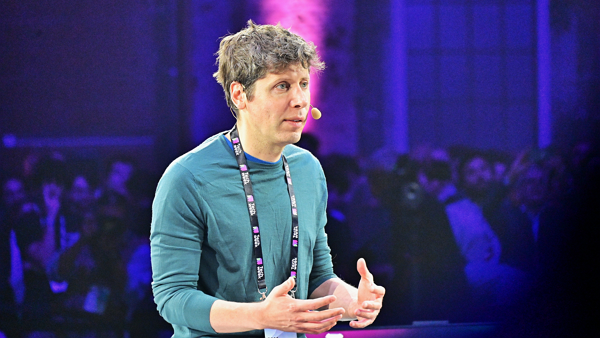
OpenAI CEO Sam Altman (샘 알트먼) predicted that overall working hours across society will not fall even if artificial intelligence spreads.
Business Insider reported on July 27, local time, that Altman drew a line under expectations that AI would open an era of a four-day workweek or shorter working hours in an interview on the podcast "Relentless".
Altman said technology has long promised to cut people’s working hours and increase leisure time, but reality has been different. He predicted that society-wide promises of a "4-hour work system" have not been fulfilled and that AI will not change that trend.
He cited human competitiveness as the reason. He said that as AI raises productivity, people will demand more results from themselves rather than work less. He added that people cannot easily escape a relative competition structure in which they judge their position by comparing themselves with others. That is at odds with earlier forecasts that AI would replace human labor and bring more leisure.
He also said that even in a world after superintelligence, people will be much busier than expected. He said people will complain but ultimately adapt to such an environment.
His remarks also tie into debate over a four-day workweek that has spread since the COVID-19 pandemic. The four-day workweek has drawn attention as an alternative to reduce employee burnout and increase flexibility. Some small and midsize companies said in 2023 that employee morale and productivity improved after adopting a four-day workweek.
But in recent months, corporate executives have been stepping up a return to five-day, in-person work. The so-called "9-9-6" culture of working six days a week from 9 a.m. to 9 p.m. is also being discussed again. Contrary to expectations of shorter working hours, a trend of demanding long hours also appears to be continuing.
In the same interview, Altman also said, "We are now inside the singularity." The singularity generally refers to a point after AI surpasses human intelligence, when it becomes difficult to predict the pace of technological progress and social change. He judged that such a phenomenon would be a very positive change globally.
Altman’s message, ultimately, is that even if AI raises productivity, it will not automatically translate into shorter working hours. He said human competitiveness and a social structure that demands higher results may have a stronger influence on how people work than technological progress.
 Yoonseo Lee
yslee@d-today.co.kr
Yoonseo Lee
yslee@d-today.co.kr