
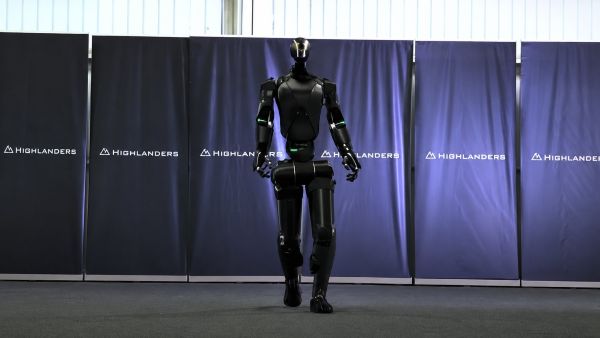
Mitsubishi is teaming up with Japanese robot startup Highlanders to mass-produce humanoid robots. It plans to secure production capacity of 1,000 units a month by the end of 2027 and deploy humanoids on its own factory production lines.
Cryptopolitan, a blockchain media outlet, reported on July 27 that Mitsubishi recently signed a memorandum of understanding with Highlanders and has begun work on jointly developing humanoid robots and building a mass-production system.
Highlanders is a robot startup spun off from the University of Tokyo in 2023. It develops general-purpose humanoids and quadruped robots based on Japanese-made parts.
The two companies have also clearly divided their roles. Highlanders will develop humanoid robots to be deployed at Mitsubishi production sites, while Mitsubishi’s Kyoto plant will serve as the mass-production base. Mitsubishi already holds a stake in Highlanders and is reported to be considering additional investment.
The company cited deepening labour shortages as the biggest driver behind the project. Mitsubishi is also pursuing a plan to place humanoids on the engine production line at its Kyoto plant. Mitsubishi Motors CEO Takao Kato (가토 다카오) set a goal of becoming a "front-runner" in mass-producing humanoids in Japan.
Highlanders also sees the partnership as more than a simple production contract. Highlanders CEO Hiroya Masuoka (마스오카 히로야) said, "Japan still does not have many companies in physical AI that can compete with global companies," and added, "Through this partnership, we want to make a step up." The remarks are interpreted as reflecting the view that Japan’s robot industry needs to shift from being centred on research and development to an actual mass-production system.
With the partnership, Mitsubishi has joined the competitive landscape with global automakers that are already testing humanoids in production settings, including Hyundai Motor, Tesla, BYD, Xiaomi and Xpeng. The auto industry is rapidly expanding investment in humanoid robots to automate repetitive tasks and address shortages of production workers.
In China, Xiaomi is conducting trial operations of humanoids at its electric vehicle manufacturing plant. The company has said the robots’ task success rate rose to 98%, narrowing the gap with humans to about 1 percentage point. Xiaomi has also disclosed a plan to deploy large-scale humanoids at factories within the next 5 years.
Xpeng has also set a goal of launching its self-developed humanoids in the global market by next year and is pursuing a strategy to transform itself into a 'physical AI company'.
Hyundai Motor is strengthening competitiveness in another way. Hyundai decided in July to buy the remaining 9.65% stake in Boston Dynamics held by SoftBank for about 500 billion won to secure full management control. Hyundai plans to deploy Boston Dynamics’ humanoid robot Atlas at its Georgia electric vehicle plant, Metaplant America (HMGMA), from 2028.
Industry sources see Mitsubishi’s move as a sign that Japan’s auto industry has also started in earnest to compete in mass production of humanoid robots and their deployment in manufacturing sites. The competition among global automakers over humanoids to address labour shortages and boost productivity is expected to intensify further.
 Jinju Hong
hongjj@d-today.co.kr
Jinju Hong
hongjj@d-today.co.kr