
Smilegate's flagship intellectual property, Crossfire, is expanding into a premium single-player narrative game. The Crossfire title under development by U.S. studio That's No Moon (That's No Moon, TNM) is a third-person strategic action-adventure game centred on an uneasy alliance between two agents from opposing factions, rather than directly carrying over the rules of the existing competitive shooter.
Smilegate held a digital briefing session on May 29 to introduce TNM's debut title. Taylor Kurosaki (테일러 쿠로사키), TNM co-founder and chief creative officer, and game director Jacob Minkoff (제이콥 밍코프) attended to explain the development direction and gameplay features. In written questions and answers that followed, they provided additional details on the relationship to the existing Crossfire IP, the adaptive cover system and the single-player narrative structure.
TNM is an independent AAA game development studio founded in 2021. Kurosaki previously served as narrative design lead for the Uncharted series at Naughty Dog, and Minkoff was lead designer on The Last of Us and Uncharted 3 at the same studio. The two have partnered for more than 18 years, including on Call of Duty: Modern Warfare (2019) at Infinity Ward, and have made combining narrative and gameplay the studio's core direction. Smilegate made a strategic investment of about $100 million in TNM in 2021.
TNM did not define the new game as a direct sequel to, or replacement for, existing Crossfire titles. It aims to keep core elements built by the Crossfire IP, including the confrontation between two factions and the tension of tactical combat, while reconfiguring them in a single-player narrative format.
Kurosaki said, "This game does not replace existing Crossfire titles or serve as a direct sequel." He described it as "a premium AAA work with a new story." He said he aimed to carry on the Crossfire IP's core DNA built over many years: the tight confrontation between two hostile factions and the tension of tactical combat.
The game's protagonists are Leila Kasem and Deloe Cross. They are agents belonging to opposing factions, but join hands to survive in the face of an overwhelming threat. The developers framed the relationship not as one built on trust, but as an unstable alliance maintained for survival. While the existing Crossfire depicted the factions' confrontation through multiplayer, TNM's Crossfire shifts that confrontation into the relationship and narrative of the two characters.
Kurosaki said, "Crossfire's strengths lie in the tight confrontation between two factions and the extreme tension that sits between them." He said that in this game, the tension is expressed through an uneasy alliance between two agents who cannot trust each other but must work together.
Players control only Leila. Cross is not a separate playable character but appears as a partner who acts independently and reacts to the player's actions. In combat, Cross helps Leila move and escape by distracting enemies or providing suppressive fire. The developers said the structure is designed so players experience the changing relationship by viewing Cross from Leila's perspective.
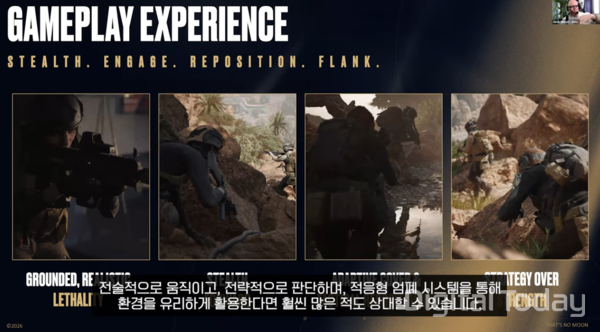
TNM highlighted gameplay as another key pillar. The game puts an "Adaptive Cover" system forward as its core differentiator. While existing third-person cover shooters relied on designated cover points and fixed animations, Crossfire adopts an approach in which a character's posture adjusts in real time depending on surrounding terrain and enemy sight lines.
Minkoff said, "If existing cinematic action games relied on designated cover points and snap animations, Crossfire removed those constraints." He said it is "a system that lets users take cover naturally anywhere in complex terrain."
The developers said they focused on the system because they viewed level design in existing cover shooters as overly standardised. Those games have built combat spaces around right-angled cover objects and limited height criteria, and players could predict where fights would happen even before entering the battlefield. TNM judged that this structure reduced immersion.
TNM approached the issue by using Unreal Engine 5's Nanite and Lumen technologies to build more complex and organic environments than before. Minkoff said the team has worked with a military advisory group for about 10 years, starting with previous projects, to reference a realistic feel for combat. He added they also reviewed examples from Eastern European airsoft arenas to see how people take cover and move in non-right-angled terrain. Based on that, they implemented a motion-matching-based adaptive cover system that adjusts posture by analysing surrounding terrain and enemy lines of sight.
Combat also puts more weight on tactical judgement than on straightforward firepower exchanges. The game requires play that blocks sight lines, changes position and attacks from the flank. The balance between stealth and combat is not fixed. In some situations, players can avoid combat through stealth and cover alone, but there are also sections where combat is unavoidable. The choice depends on the structure of the battlefield and enemy placement.
Enemy NPCs do not simply rush the player. They use squad tactics, including suppressive fire and flanking manoeuvres, and keep searching by tracking the player's last known location. Minkoff said the game will offer difficulty options from launch. He said, "It may feel difficult at first, but I hope more players can experience the fun of strategic combat without 부담 through the adaptive cover system that automatically adjusts posture."
Kurosaki said the game emphasises realism but does not make realism itself the goal. He said, "Realism is a means for immersion, not an end in itself." He said, "The core development 기준 is to keep tension from breaking."
The developers also considered that high tension could lead to player fatigue. Rather than a structure that is only combat, they plan to balance tension and release by placing quieter narrative sections that help players understand the relationship between Leila and Cross and each character's perspective.
The narrative follows a linear structure. It is not a system where players choose story branches or create characters. TNM said it will keep a linear narrative, while adopting a structure in which players can try varied tactical choices during combat. The developers said this lets them deliver a story with twists and inevitability at the same time, and strengthen detailed emotional expression using motion capture and character models.
The game also combines realistic science fiction elements. Minkoff said, "We aim for realistic science fiction," and explained that the team added science-fiction threat elements on top of a fictional world based on real scientific concepts, precise reproductions of real weapons, the sound of firefights and environmental detail. Key science-fiction settings and the specific identity of the threat will be revealed later.
Kurosaki explained the decision to keep the title Crossfire without a subtitle as meaning "respecting the strengths of the IP's long legacy while declaring the franchise's evolution." He said it is "a work that expands the Crossfire universe into a premium cinematic single-player for both existing fans and new players, rather than replacing existing competitive shooter games."
The collaboration between Smilegate and TNM is also a key backdrop to the project. Crossfire is Smilegate's flagship IP with more than 1.1 billion users worldwide. Kurosaki said, "It was impressive that Smilegate trusted our creative direction and left it entirely to us." He said Smilegate's global publishing capabilities and TNM's narrative-focused game development experience are creating synergy.
Crossfire is set to be released on PlayStation 5, Xbox Series X and S, and PC. The release date and specific play time have not been disclosed. The developers aim to make a complete premium single-player game without paid DLC.
The key question is whether the Crossfire IP, which grew as a multiplayer shooter, can also work in the premium single-player market. TNM chose to move the original's faction-confrontation structure into a character-centred narrative and to strengthen the linkage between combat and narrative through adaptive cover. For Smilegate as well, the project is expected to be a test of whether it can expand Crossfire into a global AAA IP that does not remain confined to a competitive shooter.
 Ho-jeong Lee
lhj@d-today.co.kr
Ho-jeong Lee
lhj@d-today.co.kr