
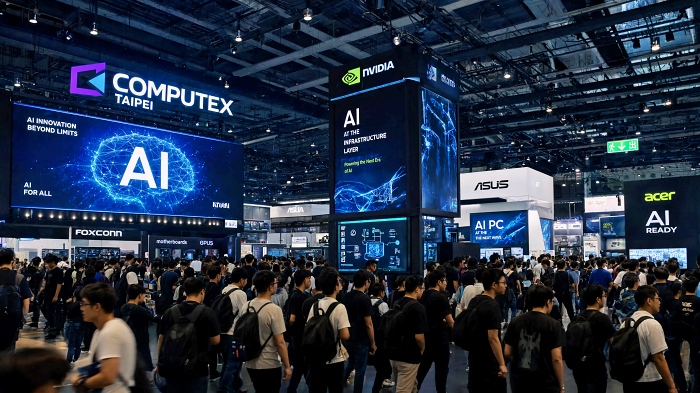
[Taipei, Taiwan = DigitalToday reporter Hyunwoo Chu (추현우)] It did not take long walking the Computex 2026 floor at the Nangang Exhibition Center in Taipei to sense something had changed. Between the familiar signs for motherboards, graphics cards and gaming gear, unfamiliar terms were everywhere this year. “AI factory”, “agentic AI”, “800VDC” and more. Computex is changing.
Computex is one of the world’s largest IT and hardware exhibitions, held annually in Taipei. If CES is a consumer event focused on finished products, Computex is closer to a venue that shows the inner workings of the hardware supply chain, from PCs and servers to semiconductors and data centre equipment. Put simply, it is an event that serves as a kind of compass for where the global IT industry may head over the next 1 to 3 years. This year, that compass needle pointed to “AI”.
The epicentre of the change is Nvidia. At the event, Nvidia showcased AI-optimised equipment such as RTX Spark and DGX Station and delivered a message that “AI now sits on a personal desk, not in a data centre.”
RTX Spark aims to run large AI models with around 12 billion parameters locally, with 128GB of unified memory. DGX Station is effectively a personal AI server, touting 748GB of memory. If the average laptop previously had around 16GB of memory, the RTX Spark line requires 128GB as a baseline. That structure increases memory per PC by 8 to 10 times.
If earlier AI PCs were limited to simple photo editing or text summarisation, this generation is different. It is designed with the level in mind of analysing internal corporate data with AI without the cloud, and of an agent opening files on its own, running code and validating results.
Walking through an exhibition hall overflowing with a huge AI wave, the most striking point was the swift response from Taiwanese companies. Taiwanese supply-chain companies such as TSMC, ASUS, Gigabyte, Delta and Lite-On were already moving a step ahead, from AI server rack design to cooling and power infrastructure.
The power sector stood out in particular. As power density in AI server racks has surged, the existing 48V-centred structure has run into limits, and moves to address this with 800VDC high-voltage direct current distribution were spotted across the show floor. Products highlighted by Delta and Lite-On, such as 110-kW power shelves and megawatt-class coolant distribution units, gave the impression they had already entered the commercialisation stage. If GPUs and memory are the flower of AI infrastructure, power and cooling are the soil that makes that flower bloom.
The same applied to cooling. As it has become hard to handle the heat of high-density AI racks with traditional air cooling alone, liquid cooling has become a basic premise rather than an option. This is why server makers such as Wiwynn put technologies such as double-sided cold plates and liquid-metal TIM at the forefront.
The wave AI has created does not stop there. Nvidia’s Cosmos 3 physical AI platform signalled the next gateway toward robots, autonomous driving and factory automation. Qualcomm’s Dragonwing platform for robots and MediaTek’s automotive and edge AI strategy also pointed in the same direction. Robots may not fill the streets this year, but it was clear where the industry’s centre of gravity is moving.
There are also points that need a cold-eyed look. Price remains a high barrier to the mass adoption of AI PCs with 128GB of memory by ordinary consumers. Physical AI will also need a long time before real monetisation. Making many AI servers does not necessarily lift the profit margins of server manufacturers as well. A dilemma also clearly exists as procurement burdens and dependence on Nvidia grow at the same time. The nature of Taiwan’s tech industry, including its particular fixation on hardware events such as Computex, is also part of that.
Even so, what was confirmed at this year’s Computex is clear. AI no longer remains only inside GPUs in cloud data centres. It is pushing into personal desks, corporate server rooms, factory floors and the inside of cars. Taiwan’s supply chain was reading this change faster than anyone and was already moving toward being fully prepared. Computex was a festival of the PC era. Now the lead role in that festival has changed. It is becoming a gathering place for pioneers building a new AI playing field.
 Hyunwoo Chu
cookinpapa@d-today.co.kr
Hyunwoo Chu
cookinpapa@d-today.co.kr