
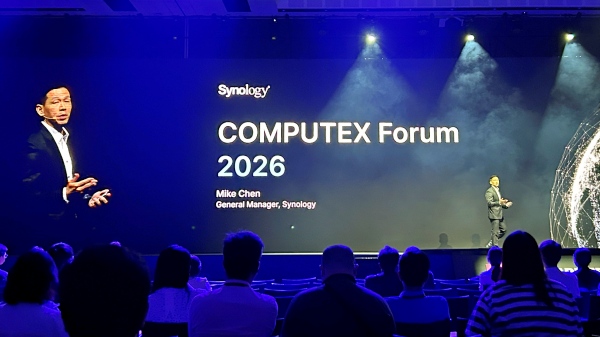
[Taipei, Taiwan=Digital Today reporter Hyunwoo Choo] "AI is now a basic technology, not a choice. The problem is that there is too much legacy data inside companies that AI struggles to handle."
Mike Chen (마이크 첸), Synology managing director, opened with those remarks at a Computex 2026 keynote session held on June 4 at the TaiNEX 2 exhibition hall in Taipei, Taiwan. The topic of his talk was "Digital sovereignty accelerates adoption of private cloud."
Chen first stressed that the shift to AI native is a sign of the times. He cited South Korea’s creation of a national AI growth fund worth more than 10 trillion won as a representative example of strategic investment. But he warned that introducing AI without properly controlling vast legacy data would shake data sovereignty itself.
He also cited Gartner survey results showing 57 percent of employees already use personal AI for work, and 33 percent admitted they directly pasted sensitive company data into external AI. "Shadow IT has evolved into shadow AI," he said.
Synology’s proposed solution can be summarised in three pillars. First is data ownership. The principle is that data should be managed with a company’s own infrastructure across the entire range from edge to data centre. Synology said it supplies solutions to remote weather observatories, submarines, aircraft and space stations, and described itself as a leader in the field.
It also highlighted scalability as a strength. It supports software cluster designs and integration with monitoring tools such as Prometheus and Grafana so that even small IT teams can run cloud-level large infrastructure like a single system. As an example, Korean Air’s aerospace division said work efficiency improved 80 percent after adopting Synology.
Second is security AI. Most corporate data is unstructured, such as PDFs, audio and text. Synology has embedded data intelligence into its system that can process 90 percent of this. Semantic search, speech-to-text conversion and OCR processing for scanned documents are all performed on premises. It also provides an enterprise productivity ecosystem spanning documents, spreadsheets, email and messengers. Translation is also processed in real time, removing the need to copy data to external AI tools.
It also unveiled a security AI agent. It automates routine tasks such as checking backup and recovery status, investigating security incidents and responding to failures, but all actions are executed only within the permission model set by the company. "An agent should not bypass permissions, but move within permissions," Chen stressed.
Third is trusted disaster recovery. Chen proposed a "new golden rule 3-2-1-1-0" that includes immutability, an air gap and recovery verification, beyond the existing 3-2-1 golden rule for preparing for worst-case scenarios such as ransomware attacks. He also introduced an active protection solution that double-checks by detecting ransomware during backup and detecting threats during recovery. It can also manage thousands of systems in a batch through multi-site and cross-site disaster recovery and a central single management screen, or Single Pane of Glass, he said.
Chen closed his talk by stressing Synology’s evolving technology and customer responsiveness in the AI era, saying: "Own your data, own your AI, own your future."
 Hyunwoo Choo
cookinpapa@d-today.co.kr
Hyunwoo Choo
cookinpapa@d-today.co.kr