
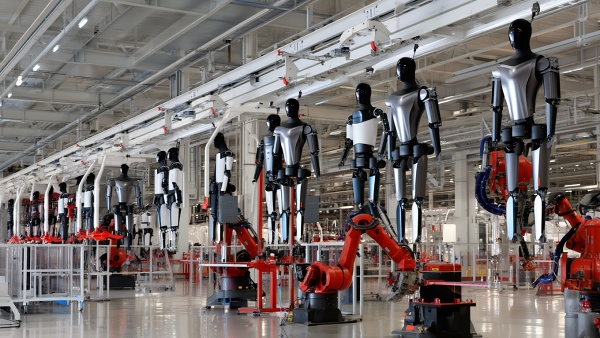
Humanoid robots are drawing attention as the next stage of the artificial intelligence (AI) revolution. The investment industry and market analysts forecast that over the next 10 years, humanoid robots will spread beyond manufacturing to services and homes, forming a new mega-market.
On June 3, CNBC reported that global investors and industry experts expect the humanoid robot market to grow rapidly, supported by advances in physical AI. SoftBank Chairman Masayoshi Son (손정의) recently mentioned that a next $1 trillion company could emerge in physical AI and robotics, raising expectations in the market.
Humanoid robots have begun to be deployed at industrial sites for tasks such as airport baggage handling, logistics automation and work on production lines. Tesla's humanoid robot Optimus, which is under development, is also cited as a representative example.
Market size forecasts are also steep. In a recent report, global investment bank Barclays defined the humanoid market as the era of "Automation 3.0" and projected the market, currently about $2 billion to $3 billion, will grow to $200 billion by 2035.
Zornitsa Todorova (조르니차 토도로바), head of research at Barclays, said the next 10 years will be the era of robots. She forecast humanoids will become a key means of addressing structural labor shortages at industrial sites. Labor shortages driven by aging, urbanization and changing job preferences are expected to accelerate adoption of humanoids. Dangerous, repetitive and undesirable work is seen as the area where robots are best suited to replace humans.
For now, humanoid robots perform relatively simple tasks such as carrying boxes or picking and moving parts on production lines. But as AI technology advances, they are expected to gradually handle more complex work.
The industry expects humanoid adoption to unfold in two stages. Through 2030, deployment is expected to expand mainly at industrial sites such as manufacturing and logistics, agriculture and construction. After that, the range of applications is expected to widen across service industries including healthcare, elderly care, education, hotels and restaurants. Demand for humanoids is projected to rise sharply in the United States and Europe, where the service sector accounts for a large share.
A prevailing view is that China currently holds the lead. According to Barclays, China accounts for about half of global installations of industrial robots, and 85 percent of newly installed humanoid robots last year were in China. Production costs are also known to be around $50,000, about half the level of Western rivals. Dan Ives (댄 아이브스) of Wedbush Securities said China is clearly in the lead in the humanoid market and the United States is in a chasing position.
The investment industry is also focusing on humanoids as a long-term growth theme. Jason Pidcock (제이슨 피드콕) of asset manager Jupiter said the world will be completely different in 10 years and forecast humanoid robots will be deployed not only in factories but also across homes, the military and government agencies. He projected that the spread of robots will sharply raise productivity while also driving growth across related industries such as semiconductors and sensors, batteries, software and telecommunications infrastructure.
Some experts are also raising the possibility that consumers could one day buy humanoid robots the way they replace smartphones or PCs.
Job shifts, safety and regulation are cited as challenges that need to be addressed. Experts point out that while the spread of humanoids could bring large-scale productivity gains, industry and governments should also prepare a balanced approach to social impacts.
The market expects the pace of technological maturity, whether costs fall, the timing of expansion into service industries, and competition between Chinese and U.S. and European companies to be key variables shaping the direction of the humanoid industry.
 Jinju Hong
hongjj@d-today.co.kr
Jinju Hong
hongjj@d-today.co.kr