
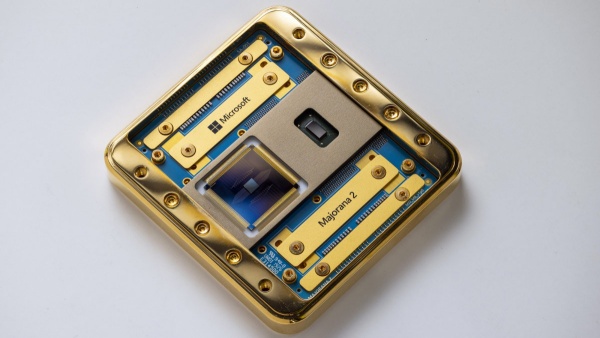
[DigitalToday reporter Jinju Hong] Microsoft has unveiled its next-generation topological quantum chip, Majorana 2, and set a goal of building a scalable quantum computer with commercial value by 2029. The company said development automation using artificial intelligence has brought forward the commercialisation timeline significantly from earlier expectations.
ITmedia Japan reported on Tuesday that Microsoft unveiled Majorana 2 and announced its quantum computing roadmap at its annual developer event, Microsoft Build 2026. The company expects the advances to cut by about half the time needed to realise a practical quantum computer versus its previous plan.
A key point of the announcement is a shift from quantum technology that had remained at the basic research stage to full-scale engineering development. Satya Nadella (사티아 나델라), Microsoft's chief executive, said at the event, "If Majorana 1 validated basic physics, Majorana 2 is a turning point that moves to an engineering-scale implementation stage."
Microsoft highlighted improved qubit stability as its biggest achievement. The company said Majorana 2's qubit reliability improved by about 1,000 times from the previous generation. It said that while typical quantum computers maintain a quantum state on a microsecond scale, Majorana 2 can maintain a quantum state for an average of 20 seconds and up to nearly 1 minute.
Chip integration has also improved significantly. Microsoft said it reduced the size of a single qubit to about 1/100 of a millimetre. It said it expects to eventually integrate up to 1,000,000 qubits on a chip smaller than a credit card.
Its operating speed is known to be about 1 microsecond. Microsoft likened it to "an improvement equivalent to using a smartphone that needs charging once a day for about 3 years on a single charge."
The company cited the use of AI as a driver of faster development. Microsoft said it is actively deploying its agentic AI platform, Microsoft Discovery, in quantum computing research. At its research hub in Denmark, the platform's AI agents are carrying out tasks including managing experiment workflows and automating measurement, optimising manufacturing processes and detecting defects.
It said AI automatically handles hundreds of parameter-setting and measurement steps needed to generate quantum states, significantly shortening research and development cycles.
Microsoft also announced it would begin general availability of Microsoft Discovery on the day. It also unveiled a preview version of the Microsoft Discovery app, which allows core functions to be used for free on personal PCs. Individual users with a GitHub Copilot account can also use the app.
The industry views the announcement as showing Microsoft's strategy of combining AI and quantum computing, beyond simply unveiling a new quantum chip. Quantum computer development has been assessed as having an uncertain commercialisation timeline due to complex experiments and repetitive measurement work.
Microsoft is increasing development speed by using AI to automate design, experimentation and manufacturing processes. The company expects that if quantum computers become practical, they could address problems that are difficult for existing supercomputers to solve, including new drug development and disease research, food production, energy efficiency and sustainability issues.
Still, industry attention is focused on whether Majorana 2 can prove its planned level of stability and scalability in real-world environments. Whether Microsoft's 2029 commercialisation target can be maintained through the development process is expected to be a key point to watch in the quantum computing market.
 Jinju Hong
hongjj@d-today.co.kr
Jinju Hong
hongjj@d-today.co.kr