
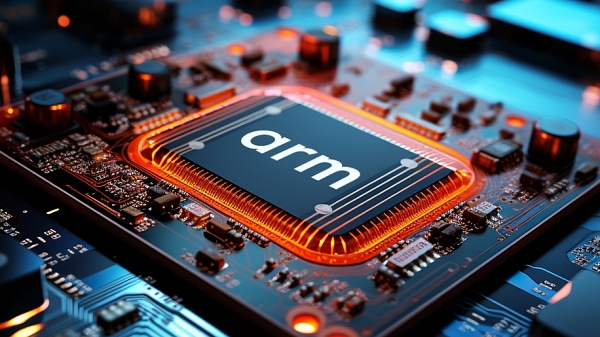
Rene Haas (르네 하스), Arm's chief executive, said datacentre CPU demand is rising faster than Arm expected as agent AI spreads. On June 2, Taiwan media outlet iThome reported that he said in a Computex keynote that the number of CPU cores needed for datacentres could rise to more than four times the current level even under the same power conditions.
Haas said investment in generative AI over the past 2 years has been mainly focused on GPUs, but the spread of agent AI is changing the structure of computing demand. If GPUs generate tokens during training and inference, agent AI does more than generate answers. It continues to carry out tasks, calls tools, manages workflows and works with other agents. He said burdens such as token management, allocation, coordination and execution shift to CPUs in the process.
Arm first unveiled its in-house 'Arm AGI CPU' in March, moving beyond supplying architecture intellectual property (IP) to enter the AI datacentre CPU product market. The product is designed for large-scale AI datacentre deployments based on Arm's Neoverse architecture and its Compute Subsystem platform.
Haas said there was a market reaction in March that Arm was overly optimistic when it forecast the CPU market size would exceed $120 billion over the next 5 years. He said perceptions have now changed about the pace of agent AI growth. He said CPU demand is rising faster than previously expected as OpenAI Codex, Anthropic, Salesforce and ServiceNow introduce agents into their products.
Arm touted power efficiency as the key competitiveness of Arm AGI CPU. According to figures presented by Arm, the product delivers about twice the performance per watt of comparable x86 systems. An air-cooled system provides 8,160 CPU cores and more than 180 TB of low-latency memory at 36 kW, while a liquid-cooled system provides more than 45,000 cores and more than 1 PB of memory at 200 kW.
Haas stressed that competition in AI datacentres is shifting from chip performance itself to computing capability per unit of power. He said 17 x86-based 2U server racks can accommodate 4,352 cores, while a configuration of 30 1U servers using Arm AGI CPU can hold 8,160 cores. Arm estimated that large-scale adoption of Arm-based CPUs could reduce power capacity by about 10 GW and cut infrastructure investment costs by more than $10 billion.
Arm AGI CPU has already been adopted by OCI and ByteDance. Datacentre CPUs such as Google Axion, AWS Graviton, and Nvidia Grace and Vera are also designed based on Arm architecture.
The agent AI shift is also spreading to the PC market. Nvidia's PC computing platform 'Nvidia RTX Spark', unveiled the previous day, includes a MediaTek-custom Grace CPU, which is also based on Arm architecture. Nvidia CEO Jensen Huang (젠슨 황) said PCs will change from devices where people run apps directly into computing platforms where agents perform tasks. He also said a new NVFP4 model compression format will allow PCs to run AI models with 100 billion parameters, enabling many agent tasks to be handled directly on devices rather than in the cloud.
 DigitalToday
ittodaynews@naver.com
DigitalToday
ittodaynews@naver.com