
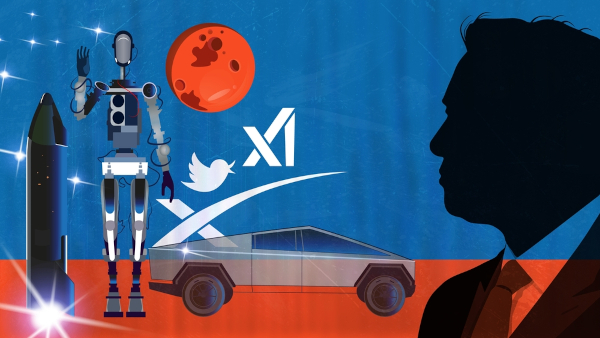
As SpaceX pursues an initial public offering at a valuation of more than $1 trillion, losses in its AI business, uncertainty over Starship development and about $30 billion in debt have emerged as key risk factors. On May 30 local time, The Verge reported that SpaceX's registration statement included growth plans as well as financial burdens, affiliated transactions and voting power concentration issues.
In the filing, SpaceX put its total addressable market at $28.5 trillion. It set $26.5 trillion of that as the AI applications market, showing that its business focus is structured closer to AI than space. About two-thirds of its capital expenditure of about $13 billion in 2025 also went to expanding AI infrastructure. But the AI segment posted an operating loss of $6 billion that year, and revenue was only $3.2 billion. In the first quarter of 2026, AI segment revenue including X and xAI was $818 million.
Questions were also raised about its AI competitiveness. SpaceX was shown to have leased large-scale cloud computing facilities to Anthropic at an annual scale of $15 billion. By contrast, the AI model Grok was introduced in the filing as one of the world's top-tier frontier models. Musk said in March that xAI was not built properly from the start and was rebuilding it from the foundation. The filing also again mentioned content that OpenAI co-founders Greg Brockman and Ilya Sutskever had seen in 2018 that Musk did not sufficiently understand AI and AGI.
A deal with AI coding company Cursor was also cited as a burden factor. If the deal is completed, existing shareholders would have to accept dilution of $60 billion. Even if the deal falls through, SpaceX would have to pay Cursor $1.5 billion and provide more than $8 billion in computing resources.
Uncertainty remains over Starship, the core of its space business. SpaceX wrote that it would deploy next-generation V3 satellites with Starship in the second half of 2026 and could launch up to 60 at a time. But in a test flight on May 22, two days after the filing was made public, 1 engine failed and the booster exploded during its return.
By contrast, Starlink was cited as a business that generates substantial cash. Starlink posted more than $11 billion in revenue last year. Revenue per subscriber fell by about 25 percent.
The financial burden is also heavy. SpaceX's debt listed in its risk factors is about $30 billion. Before listing, it refinanced part of its borrowing with a $20 billion bridge loan, paying an early repayment fee of $1 billion in the process. Under the contract, the first $20 billion raised in the IPO must be used first to repay that debt. It also emerged that the xAI acquisition triggered a technical default under a $1.5 billion credit support commitment.
Its governance structure is also unfavorable for retail investors. Musk holds 80 percent of SpaceX voting rights. It was pointed out that arbitration clauses could also make securities-related lawsuits more difficult. A change in Nasdaq rules has also prompted talk that it could be included in the Nasdaq 100 just 15 days after listing. In that case, forced buying by index-tracking funds could follow.
 Hyunwoo Choo
cookinpapa@d-today.co.kr
Hyunwoo Choo
cookinpapa@d-today.co.kr