
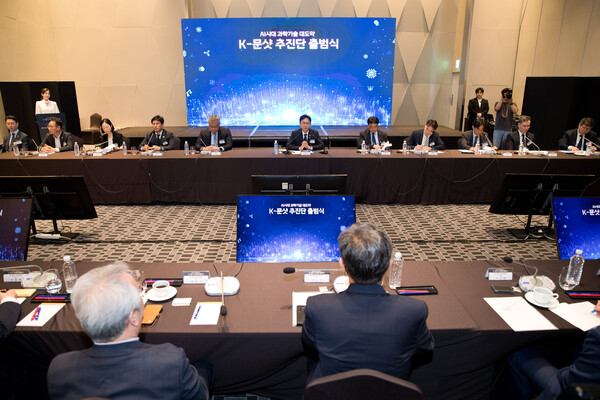
The K-Moonshot project has taken its first step to solve national challenges by combining science and technology with artificial intelligence (AI). The government appointed 12 project directors (PDs) to lead 12 national missions and formed an inter-ministerial implementation system, moving into the execution phase.
The Ministry of Science and ICT on May 27 appointed 12 PDs to lead K-Moonshot missions and held a launch ceremony for the K-Moonshot taskforce.
◆ Set 12 missions, double research productivity by 2030
K-Moonshot aims to actively introduce AI into science and technology to double research productivity by 2030 and solve 12 national missions needed for a major leap in national competitiveness by 2035. The plan goes beyond distributing AI tools to researchers and instead makes AI a core infrastructure that changes the R&D approach itself.
A moonshot refers to a challenge goal that is difficult to achieve, like a lunar landing, but has large ripple effects if successful. K-Moonshot is being 추진 in the same context. It aims to bring forward solutions to science and technology challenges that would have taken a long time under existing R&D systems by using AI-based research methods.
K-Moonshot was influenced by the "Genesis Mission" announced by the U.S. White House in November last year. Genesis Mission is a U.S. government-level science and technology innovation plan to use AI to speed up scientific discovery and technology development.
The 12 national missions set by the government are major tasks that are difficult to solve by individual ministries or research institutions. Representative missions include accelerating new drug development by 10 times, as well as commercialising brain implants, developing a Korean-style small fusion demonstration reactor and demonstrating power generation, securing and demonstrating core technologies for a space data centre, and internalising general-purpose physical AI models and computing. Other areas directly tied to national competitiveness are included, such as solar cells, bio, space, materials, semiconductors and quantum.
◆ Speed up science and technology development with AI, rally science administration through the taskforce
Science and technology development that requires long periods of time and large costs under existing methods can proceed faster by using AI. The government is looking to K-Moonshot for that. If AI analyses vast research data and optimises experimental conditions, researchers can reduce time spent on trial and error.
For example, in new drug development, AI can be used to shorten development time by supporting candidate searches, toxicity prediction and reviews of clinical feasibility. While existing R&D programmes operated around individual projects, K-Moonshot first sets goals for the state to solve and then brings together technology, talent, budgets and policy tools to achieve them.
The government plans to speed up mission progress under a PD-led structure and to establish early a cooperation framework between relevant ministries and research sites. For K-Moonshot to produce results, AI infrastructure and a data utilisation system must also support it. That is because using AI in science and technology requires large-scale research data, high-performance computing resources and domain-specific expert models.
The National Science AI Research Center (NAIS) will support data and computing power. It will support science and technology research through a graphics processing unit (GPU) platform and a data platform, and develop and expand a science AI operating system platform. NAIS, which has already been established, will soon officially appoint a head and then begin full-scale operations.
The 12 appointed PDs will serve as overall managers for each mission. They will coordinate the entire process, from setting mission goals and planning tasks to managing research implementation and using results. The taskforce launched on the day will oversee K-Moonshot policy, with Vice Prime Minister Bae Kyung-hoon (배경훈), who also serves as science and ICT minister, as its head. It will check PDs' mission performance and rally national science administration capabilities through policy coordination with relevant ministries and R&D cooperation. Bae said, "We will solve problems at industrial sites through K-Moonshot," and added, "We will concentrate our capabilities to navigate the era of the AI revolution."
A workshop held alongside the launch ceremony was arranged to discuss future implementation tasks. Participants shared each mission's 추진 direction, cooperation methods and the schedule ahead, and discussed detailed implementation strategies.
Bae said that to take the lead in the AI hegemony competition, securing AI competitiveness is important, but what to accomplish through it and the ultimate goal are more important. He stressed that he would 추진 K-Moonshot with a sense of mission to solve problems facing humanity.
 Jin-ho Lee
jhlee26@d-today.co.kr
Jin-ho Lee
jhlee26@d-today.co.kr