
[DigitalToday reporter Jinju Hong (홍진주)] The United States and China are moving into a full-fledged lunar exploration race targeting the area near the Moon’s south pole Shackleton crater. Strategic competition is taking shape over securing water ice resources and building future bases.
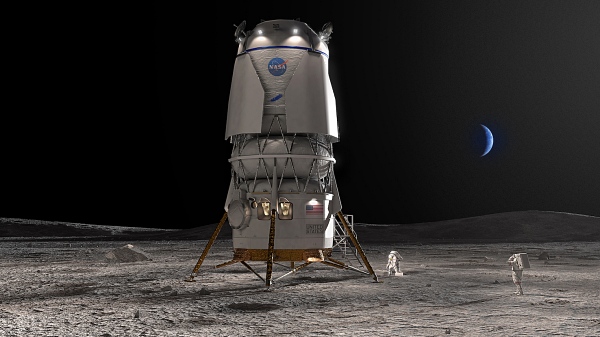
IT outlet Ars Technica reported on April 16 local time that Blue Origin’s Endurance lunar lander and China’s Chang’e 7 mission are expected to launch around the same time in the second half of this year and attempt landings near the rim of Shackleton Crater.
The two missions go beyond a simple race to land and take on the character of competition for south pole resources. Shackleton crater is a permanently shadowed region where sunlight does not reach, and it is considered a site with a high likelihood of large-scale water ice. The crater rim, by contrast, receives almost continuous sunlight, making it favorable for solar power. It is drawing attention as a candidate site for a next-generation lunar base that could meet both ice mining and energy needs.
Endurance is the first test-flight lander based on Blue Origin’s Blue Moon Mark 1 design. It is about 8 metres tall, larger than the Apollo Lunar Module from more than 50 years ago. After completing extreme-environment testing at the Johnson Space Center in Houston, it moved to Cape Canaveral, Florida. It is expected to launch aboard the company’s heavy-lift New Glenn rocket.
China’s Chang’e 7 mission uses a relatively small lander, but it is designed as a combined mission that also deploys an orbiter, a rover and a flying probe. China is already preparing for launch at a spaceport on Hainan island and has begun integration work with the Long March 5 heavy rocket. After landing, it plans to use the rover and flying probe to study the inside of the crater and surrounding soil, and directly analyze the amount and distribution of water ice.
Launch timing for both is expected after late summer this year, but it is still uncertain which side will land first. If the two craft operate at the same time at close range, it has been raised as a possibility that this could be the first case of exploration equipment from different countries being run in parallel so close together on the lunar surface.
The mission goals are clearly distinct. For Endurance, the key is first to succeed in precision landing itself. Blue Origin has not disclosed an exact landing site, but founder Jeff Bezos has mentioned plans to land near Shackleton crater. Endurance will carry a NASA-supported camera and a laser reflector to measure interactions between engine plumes and lunar soil during landing, as well as the landing position.
Chang’e 7, by contrast, places emphasis on exploration after landing. China has set as a main goal directly confirming the presence and origin of water ice in the south pole region. This also connects to U.S. plans for Moon south pole exploration to be pursued through VIPER, an exploration robot.
This competition also has the character of a precursor to building lunar bases in the 2030s and a race for crewed lunar landings. The United States aims to send astronauts back to the Moon as early as 2028, and China is also pursuing a crewed lunar landing by 2030. Analysts say competition is inevitable as both countries view the Moon’s south pole as a strategic foothold.
Legal and diplomatic issues are also coming into focus. Under the Outer Space Treaty, claims of sovereignty over celestial bodies such as the Moon are prohibited, but installation of bases is allowed. This has prompted the view that the country that enters first could influence the formation of future norms.
In this context, the United States has proposed a concept of “safety zones” to minimize interference between lunar activities, and Artemis Accords signatories are accepting it. About 60 countries are participating, but China and Russia are not included.
Experts expect activity near the Moon’s south pole to become even more concentrated. That is because robot exploration and crewed missions are likely to focus on areas within 100 miles of the south pole. As the region holds strategic importance alongside scientific value, competition over access to resources and leadership in setting norms is expected to intensify.
 Jinju Hong
hongjj@d-today.co.kr
Jinju Hong
hongjj@d-today.co.kr