
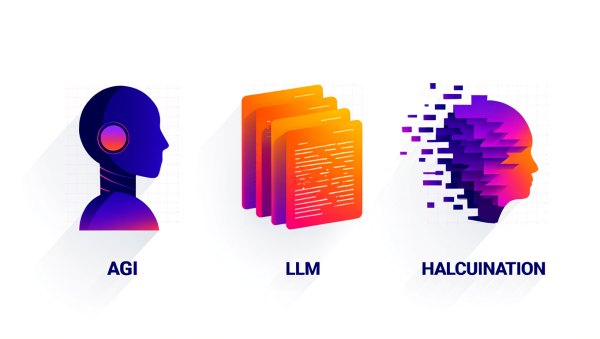
As generative artificial intelligence (AI) spreads, technical terms such as artificial general intelligence (AGI), large language models (LLMs), hallucinations and tokens are becoming a common language across industry. The AI sector widely uses specialist terminology to explain research and products, infrastructure and safety issues, and there is an assessment that understanding it is needed to read corporate strategy and market trends.
On April 12 local time, IT media outlet TechCrunch put together key AI terms, summarising their concepts and usage in one place.
The most representative concept is the LLM. LLM refers to the large language models that underpin AI chatbots such as ChatGPT, Claude, Gemini, Llama and Copilot. When a user enters a question, the model generates an answer by stringing together words that are most likely to come next, based on vast text patterns it learned. In this process, the service name and the model name can differ. For example, GPT is OpenAI's model, while ChatGPT is a service that uses it.
There is also no agreed definition yet for AGI, a term the industry often puts forward. Sam Altman (샘 알트먼), OpenAI's chief executive officer, recently described AGI as "a median human that you can hire as a co-worker." By contrast, Google DeepMind places more weight on AI that broadly performs cognitive tasks at a level similar to humans. That is why interpretations differ even at the industry's leading edge.
The expression that appears most often in recent product competition is AI agent. It refers to systems that go beyond simple conversational chatbots to carry out multi-step tasks on a user's behalf, such as expense processing, reservations, code writing and maintenance. Agents, too, do not have a settled general definition, and the infrastructure needed for actual implementation is still being built. For now, the core direction presented is to connect multiple AI systems to autonomously handle multi-step tasks.
To understand model performance, it is necessary to distinguish training from inference. Training is the process of feeding in data so the model learns patterns, while inference is the stage where a trained model actually produces predictions and responses. Training requires large amounts of data and computing resources, and it is costly. Inference, by contrast, determines speed and cost at the service stage. Hardware ranging from smartphone chips to high-performance graphics processing units (GPUs) and dedicated AI accelerators can handle inference, but the larger the model, the greater its reliance on high-performance infrastructure.
For that reason, computing resources and memory semiconductors are cited as bottlenecks in the AI industry. The industry refers to the computing resources that make AI model training and deployment possible as "compute." This includes hardware such as GPUs, central processing units (CPUs) and tensor processing units (TPUs).
From the standpoint of AI safety, the most direct problem cited is hallucination. Hallucination refers to when a model plausibly generates information that is not true. Its impact is greater in areas that could lead to real risks, such as health information. That is also why major generative AI services ask users to verify results. As a result, development of AI models specialised for specific industries has been drawing more attention recently.
Tokens are a standard used to determine usage costs. Tokens are data units that break down the sentences a person enters and the answers generated by a model into small pieces. They can be divided into input tokens, output tokens and inference tokens, and in enterprise AI services, token usage becomes the billing standard. The structure is such that the more a company uses AI services, the more tokens are processed and the higher the cost rises.
Ultimately, to understand the AI industry, it is necessary to read the meaning of terms before product names. AGI still lacks a settled definition, the meaning of agents varies depending on the level of implementation, and hallucinations remain a key risk that has not yet been resolved. As the spread of generative AI continues, understanding these terms is expected to go beyond tracking technology trends and become a basic premise for interpreting the industry's direction and providers' strategies.
 Yoonseo Lee
yslee@d-today.co.kr
Yoonseo Lee
yslee@d-today.co.kr