
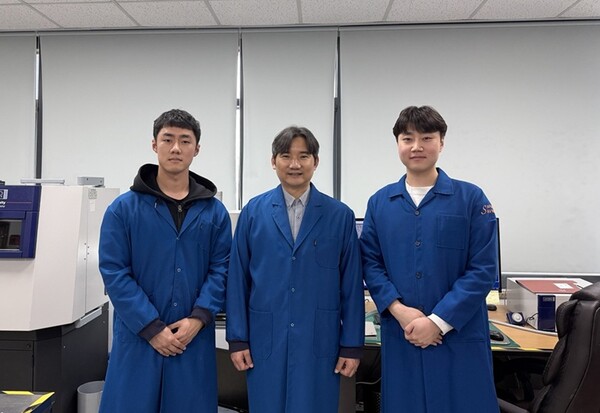
KAIST said on Tuesday that a research team led by Seungbeom Hong (홍승범), a professor in the Department of Materials Science and Engineering, published a review paper that organises and analyses atomic force microscope (AFM)-based ferroelectric research strategies and presents methodologies and strategic guidelines for analysis and manipulation.
The team presented new strategies for using AFM to precisely control electricity in the nano world and laid out directions for next-generation advanced materials research.
Ferroelectrics have electrical polarity (polarisation) like magnets, and using this makes it possible to implement memory that retains information even when power is cut, or precision sensors. As semiconductor devices have become increasingly miniaturised, subtle physical phenomena that occur at the nanoscale have come to determine the performance of entire devices.
The team presented an integrated analysis system that uses AFM to observe materials at the nanoscale and directly manipulate them. AFM scans surfaces with an extremely fine probe and reads atomic-level information.
Based on AFM, which scans sample surfaces with a fine probe to measure atomic-level physical and electrical characteristics, the team combined various analysis techniques into a single framework. These include piezoresponse force microscopy (PFM) to measure electromechanical responses, Kelvin probe force microscopy (KPFM) to measure surface potential states, and conductive AFM (C-AFM) to measure current flow. The system is designed to capture material structure and charge distribution in three dimensions.
AFM can directly apply electrical stimuli or pressure to very small nanoscale areas to change and control the properties of materials. The paper summarised that AFM has evolved into a tool that can be used to design and experiment in desired forms, rather than simply to observe.
The study also emphasised that AFM is used to confirm and improve the performance of next-generation semiconductor materials such as two-dimensional transition metal dichalcogenides like molybdenum disulfide (MoS2) and ultrathin hafnium-zirconium oxide (HfZrO2 systems).
It also proposed, as a future direction for technological development, combining high-speed atomic force microscopy (High-speed AFM) with artificial intelligence (AI) to quickly understand complex nano structures that are difficult for humans to analyse and to efficiently design better materials.
"This study shows that AFM has established itself as a key process tool for designing new materials and controlling them precisely, beyond being a simple observation device," Hong said. "Analysis technology combined with AI is expected to play an important role in securing a technological edge in next-generation semiconductor and energy materials."
The results were selected as the front cover paper and published in the international journal Journal of Materials Chemistry C, issued by the Royal Society of Chemistry in Britain.
 Jin-ho Lee
jhlee26@d-today.co.kr
Jin-ho Lee
jhlee26@d-today.co.kr