
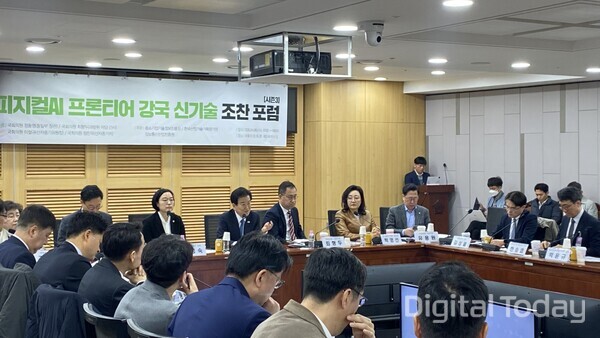
South Korea's Ministry of SMEs and Startups has presented building AI factories as a new policy goal to drive manufacturing innovation among small and medium-sized companies.
Minister Han Sung-sook (한성숙) said at the "Physical AI Frontier Powerhouse New Technology Breakfast Forum" held on April 8 in Seminar Room 2 of the National Assembly Members' Office Building in Yeouido, Seoul, that "the answer to innovation for small manufacturers is smart factories" and that they should be upgraded into AI-autonomous factories.
The push for AI factories is based on results from the ministry's earlier effort to introduce smart factories. Han said defect rates fell 45 percent and productivity rose 54 percent at companies that adopted smart factories. She said the ministry confirmed in the field that higher productivity leads to higher sales and increased employment.
Park Yong-soon (박용순), the ministry's head of policy, said it would set building autonomous smart factories and AI factories as a new goal. He presented manufacturing data standardisation as a key task. Park said there is clearly a gap between Physical AI and smart factories and that the key to closing it is data standardisation. He explained that manufacturing data must be standardised to develop AI agents and embed them in hardware to advance toward Physical AI. The ministry plans to upgrade a system for manufacturing data standardisation and wider collection through 2030 and make it available to small businesses.
The ministry plans to shift to package support that bundles grants, loans and guarantees. It also plans to respond through programmes to strengthen AI capabilities for incumbent workers and by fostering specialised AI research personnel. It will also build a customised support system tailored to types such as food, fashion and beauty by industry, and industrial complexes and large-small partnership suppliers by region. It also unveiled an integrated AI brand, "AI Plus", covering manufacturing, startups and small business owners.
At the forum, data standardisation and securing global competitiveness were cited as key tasks.
Choi Jae-won (최재원), a director at NHN Cloud, said small and medium-sized companies could be better positioned in the era of Physical AI. He also said AI agent performance depends on data architecture and called for public discussion, standardisation and making data a national asset. He said it was time for change that considers mass production rather than remaining at proof of concept.
Suppliers to global companies also raised practical difficulties. Kim Min-ho (김민호), an executive director at SimTech, a memory printed circuit board company, said global customers such as Apple and Broadcom each present 200 requirements for smart factories. He said a role is needed at the national level to identify what large companies demand of small and mid-sized partner firms and provide advice.
Cho Joon-hee (조준희), chairman of the Korea Artificial Intelligence Industry Association, said there is a limit to improving national competitiveness by only making existing industries more efficient through AX. He called for the format of government task programmes to change so AI can be fostered as a new export industry.
The forum was hosted by lawmakers Jeong Dong-young (정동영), Jeong Jin-wook (정진욱) of the Democratic Party, and Choi Hyung-doo (최형두) and Lee Cheol-gyu (이철규) of the People Power Party. It was organised by the Korea Technology and Information Promotion Agency for SMEs (TIPA), the National IT Industry Promotion Agency (NIPA) and the Korea Institute for Advancement of Technology (KEIT). Attendees included representatives from large and mid-sized companies such as Hyundai Motor, Posco, HL Mando and Doosan Robotics, startups such as Dime Research and Sizzle, and academia including Seoul National University, the Korea Advanced Institute of Science and Technology (KAIST) and Korea University.
 Seul-gi Son
sageson@d-today.co.kr
Seul-gi Son
sageson@d-today.co.kr